

Quick Answer
Exam day is roughly 3–4 hours including breaks. You start with Reading+Writing (75 min), then Listening (30 min), then Speaking (about 15 min per pair). Bring your passport/ID and arrive 20 minutes early. Results typically come 6–8 weeks after the exam via the CAPLE portal or your test centre. If you pass, you receive the certificate by post.
Dates, the €95 fee and registration are in the CIPLE A2 exam guide. This post covers the day itself: check-in, paper order, the speaking test and results.
You know the three sittings on paper. Exam day is different: check-in rules, section order, paired speaking, and when results actually land on CAPLE.
Centres follow the same CAPLE format, but room layout and speaking pairs vary. This page maps the standard flow so you are not guessing on the day.
Before Exam Day
What you'll receive by email
After registering, CAPLE sends you several emails in Portuguese — all the official communication is in Portuguese, so be prepared for that. These emails confirm your exam centre, date, and what to bring. Closer to the date, you'll receive a separate email with the specific venue address and room assignment. This typically arrives 7 to 10 days before the exam.
Keep an eye on your inbox (including spam). The exam centre address is sometimes different from the university or institution where you registered.
What to bring
- Valid photo ID — the same document number you entered during registration. If there's a mismatch, you may not be allowed to sit the exam.
- A pen (blue or black ink)
- A pencil and eraser (useful for the listening section answer sheet)
- Nothing else is needed. Dictionaries and phones are not permitted.
Arriving at the Exam Centre
Arrive early — at least 20–30 minutes before the start time. Most centres in Portugal are university faculties, and finding the correct building and room can take time if you're not familiar with the campus.
At the Faculdade de Letras in Lisbon (one of the most common centres), candidates often queue outside before being directed to their room. Staff check your ID at the door. Latecomers are not admitted once the exam has started.
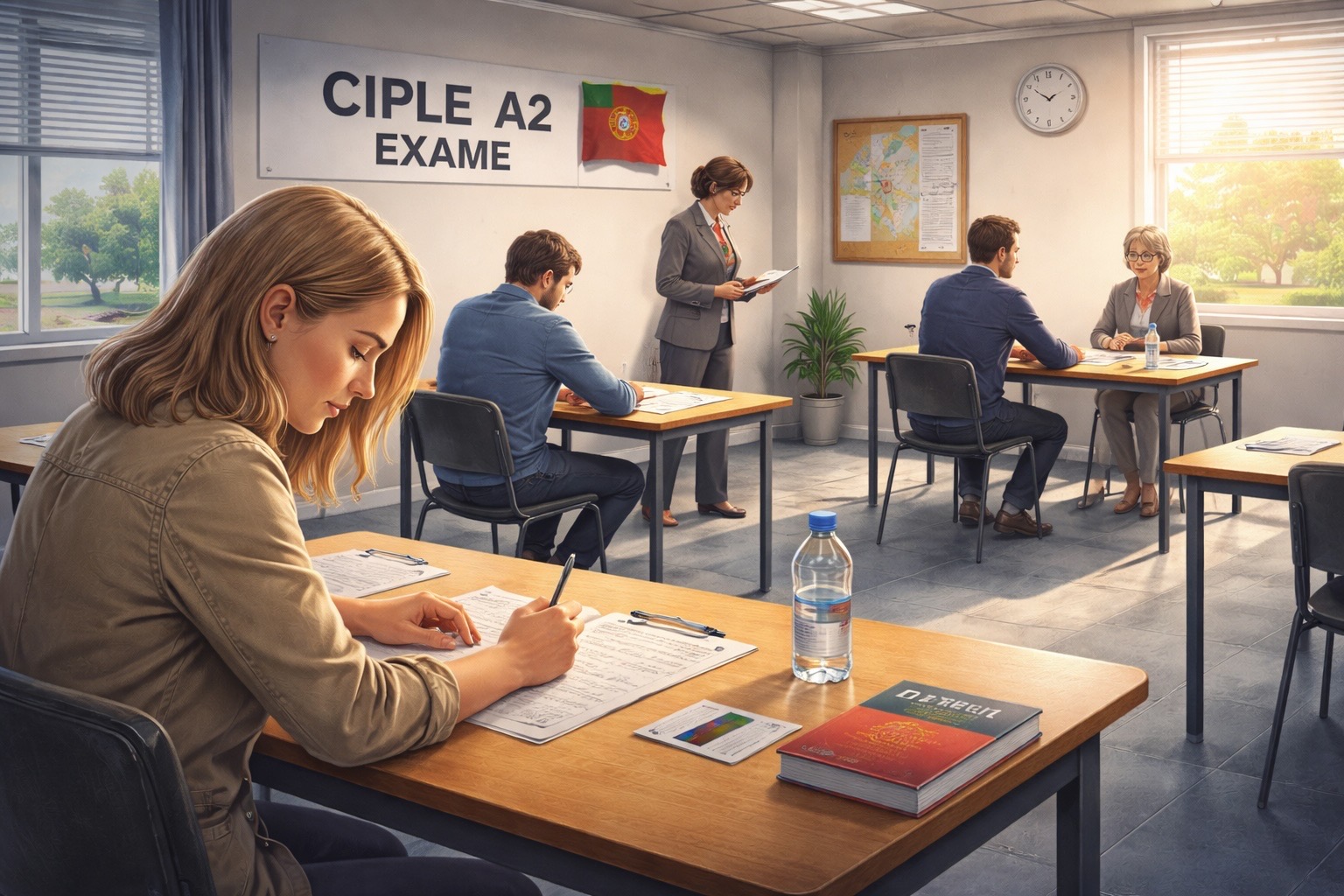
Expect a hall with spaced desks, an answer sheet, and a sealed booklet at your seat. Wait for the invigilator before you open anything.
The Three Sittings — In Order
The exam runs as three separate components, all on the same day. The order is fixed:
1. Reading and Writing — 1 hour 30 minutes (45% of score)
This is the longest section and the first one you'll sit.
Reading part: Reading+Writing opens with short texts — ads, notices, messages, sometimes a longer piece — in the booklet. Questions test main ideas and detail, not literary analysis.
What catches people off guard: the reading texts are often mundane (a notice about a community event, a classified ad, a short email) but the questions require careful reading. A common mistake is to answer based on general knowledge rather than what the text actually says.
Writing part: Two written tasks.
- Task 1: Short text, 25–35 words. Typically a note, message, or short reply.
- Task 2: Longer text, 60–80 words. Typically a description, a semi-formal message, or a short letter.
Word limits are enforced. Examiners deduct marks for texts that are significantly over or under the limit. Count your words before moving on.
Many candidates do the writing tasks first while focus is fresh, then return to unfinished reading items inside the 75-minute block — if your centre allows that order within the combined paper.
2. Listening — 30 minutes (30% of score)
A break of around 15–20 minutes separates the reading/writing and listening components.
The listening section is consistently described as the hardest part of the CIPLE — harder than most candidates expect, and harder than practice recordings suggest. Here's why:
- Audio is played over speakers, not headphones. Room acoustics vary. In a large hall, candidates near the back can struggle to hear clearly.
- Each recording is played once only. There is no replay. This is official CAPLE policy, not an individual examiner's choice.
- Background noise is included deliberately. Many recordings feature sounds that simulate real-life contexts: ambient café noise, a public address system, traffic in the background. This is intentional — the exam tests real-world listening, not studio-quality audio.
The content includes: short announcements, brief phone messages, a radio segment, a conversation between two people. Questions are multiple choice. You mark answers on a separate answer sheet.
Strategy: read the questions before each recording starts. The audio plays while you're still reading — you need to be ready before it begins.
3. Speaking — about 15 minutes per pair (25% of score)
The speaking component takes place in a separate room, with a different examiner. You are paired with another candidate and assessed together — this is the interação oral (oral interaction) format. You and your partner complete tasks together: describing a picture, a short roleplay scenario (buying something, making a complaint, asking for information), and a brief conversation on a familiar topic.
Speaking is paired with whoever shares your slot. You do not choose your partner; treat it as a short dialogue, not a solo performance.
The examiner does not participate in the conversation. They observe and score.
Speaking appointments are sometimes scheduled on a different day from the written components at some centres. Check your confirmation email carefully — if your speaking test is on a separate day, missing it means failing the entire exam.
After the Exam
Results
Results are published approximately 6 weeks on the CAPLE portal at caple.letras.ulisboa.pt — usually six to eight weeks after the session. Log in with the candidate number and password from registration.
The grading scale:
- Muito Bom (Very Good): 85–100%
- Bom (Good): 70–84%
- Suficiente (Sufficient/Pass): 55–69%
- Insuficiente (Fail): below 55%
One useful tip from a test-taker: after retrieving your result on the CAPLE website, clicking the print button reveals a breakdown of your scores for each section — not just your overall grade. This isn't prominently advertised but is there if you look for it.
Minimum section scores
CAPLE publishes no separate minimum per section — only the 55% weighted total. The listening section is still dangerous: it carries 30% of the grade, so a very poor listening score can pull you under 55% even if your reading/writing is decent.
Certificate
Once you pass, CAPLE issues your certificate. The diploma has no expiry date: it remains valid for future citizenship or residence applications. Follow current AIMA guidance for your specific procedure—administrative checklists can change, but you do not need to retake CIPLE because the certificate “ran out”.
If you fail, you can retake the exam at the next available session. Your scores from the failed attempt are not carried forward — you sit all three sittings again.
What Test-Takers Wish They'd Known
"The listening section caught me completely off guard." Multiple candidates who passed with comfortable scores on reading and writing report nearly failing because the listening was harder than any practice material they'd used. The background noise in recordings is not present in most preparation resources.
"I underestimated how much the word count matters on writing." The 25–35 and 60–80 word limits are strict. A response that's technically correct but 50 words short of the minimum will be penalised.
"The speaking partner format is less frightening than it sounds." Most people who worried about the speaking section found it the easiest part on the day. Having another candidate to converse with removes the pressure of performing solo.
"Each exam session is different." The topics that appear in the reading texts change every session. Candidates who prepared by studying the specific content of previous exams were sometimes surprised to find entirely different topics. The format stays consistent, but the content does not repeat.
"Book your slot before you start preparing." Not a day-of insight, but a pre-exam one. Candidates who waited until they felt ready to book often found slots were gone. Book first, then prepare.
Quick Reference: Exam Day Checklist
□ Photo ID (matching your registration document number exactly)
□ Pen (blue or black)
□ Pencil and eraser
□ Confirmation email (with room number and address)
□ Arrive 20–30 minutes early
□ Check if speaking component is same day or separate
□ Phone off and out of sight before entering
Preparing for CIPLE A2? Prep2Go builds a personalised day-by-day study plan based on your exam date and available study time. Start preparing →
Source: CAPLE - Camões Institute for Portuguese Language Certification