

Quick Answer
DELF B2 has four sections worth 25 points each: Listening, Reading, Writing, and Speaking. You need 50/100 overall, but one score below 5/25 can fail the whole exam. Start by checking the table, then use the section notes to decide where your prep is weakest.
The DELF B2 format is simple on paper. The risk is preparing as if it were four separate school tests, then losing the exam because one skill falls below the floor. Below: the structure, the scoring rule that matters, and the mistake to avoid in each section.
Quick overview
| Section | Duration | Points | Minimum (note éliminatoire) |
|---|---|---|---|
| Listening (Compréhension orale) | 30 min | 25 | 5/25 |
| Reading (Compréhension écrite) | 60 min | 25 | 5/25 |
| Writing (Production écrite) | 60 min | 25 | 5/25 |
| Speaking (Production orale) | 15 min + 10 prep | 25 | 5/25 |
| Total | ~3.5 hours | 100 | 50/100 to pass |
Pass mark: 50/100 overall. Note éliminatoire: scoring below 5/25 in any single section means an automatic fail, regardless of your total.
The note éliminatoire: the rule you cannot ignore
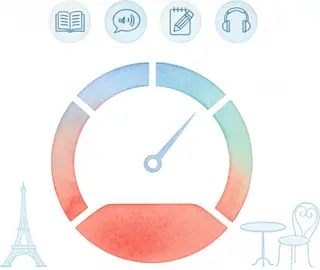
Before you split study time, understand this rule. One skill below the floor ends the exam — even with a strong total.
If you score below 5 out of 25 (20%) in any single section, you fail the entire exam — even if your total is 80/100.
Real example
| Section | Score | Status |
|---|---|---|
| Listening | 21/25 | OK |
| Reading | 22/25 | OK |
| Writing | 19/25 | OK |
| Speaking | 4/25 | Eliminated |
| Total | 66/100 | FAIL |
This candidate scored 66/100 and still failed because Speaking was below 5/25. DELF B2 rewards balance: three strong papers cannot rescue one section below the floor.
Section 1: Listening — Compréhension orale (30 minutes, 25 points)

What it tests
B2 listening assesses whether you can follow complex spoken French: arguments, nuance, and implied meaning — not only the main topic of a simple conversation.
Exam format
Two audio documents:
Document 1 (long): a radio interview, debate, or documentary extract, typically 3–5 minutes. One speaker may interview another, or two people discuss an issue. Questions check whether you understood the main argument, the speaker’s position, specific details, and implicit meaning.
Document 2 (shorter): a news report, radio feature, or cultural commentary, typically 2–3 minutes. Questions focus on extracting specific information — statistics, dates, names, stated positions.
Each document is played twice. You have time to read the questions before each listening.
Question types
- Multiple choice (4 options)
- True / false / not mentioned
- Short-answer (fill in missing information)
- Matching (e.g. speakers to positions)
What’s different from B1
At B1, you follow the main points of clear, standard speech. At B2 you are expected to: understand the structure of an argument; distinguish the speaker’s view from views they describe; notice irony, implication, and hedging; follow rapid speech with reduced forms and natural hesitation.
What trips candidates up
Trying to understand every word — B2 listening is about following the argument, not transcribing. Not using the full reading time before each document. Confusing the speaker’s view with views they are reporting in debates and interviews.
How to prepare
Listen daily to France Inter, France Culture, and RFI from week one. Practice with debates and interviews where several positions are expressed — not only short dialogues.
Section 2: Reading — Compréhension écrite (60 minutes, 25 points)

What it tests
B2 reading tests comprehension of complex, authentic texts. You must grasp explicit content, infer implicit meaning, and identify the author’s position and rhetorical structure.
Exam format
Two texts (occasionally three shorter ones). Text 1 (long): an article from a French newspaper or magazine (e.g. Le Monde, Le Figaro, L’Express, Le Point) — roughly 400–600 words on a social, cultural, scientific, or civic topic. Text 2: may be a formal letter, opinion piece, report extract, or another article; sometimes you compare two positions.
Question types
- Multiple choice
- True / false / not mentioned (sometimes with justification)
- Short-answer comprehension
- Gap-fill with provided words
- Matching (multi-text exercises)
What’s different from B1
B1 uses straightforward texts about familiar situations. B2 texts are written for native speakers, are longer and denser, use abstract vocabulary and formal register, and often require inference beyond literal statements.
What trips candidates up
Running out of time — aim for roughly 25–30 minutes per text. Answering from general knowledge instead of the text (especially on “not mentioned”). Missing tone and implicit stance — hedging and irony are part of the task.
How to prepare
Read Le Monde, Le Figaro, or Courrier International in the original — not simplified readers. Spend ~20 minutes per day on opinion and analysis pieces; they match the exam better than short news briefs alone.
Section 3: Writing — Production écrite (60 minutes, 25 points)
What it tests
B2 writing tests whether you can produce a structured argumentative text — not a simple email or pure description — on a civic or social topic.
Exam format
One task, about 250 words. You receive a short prompt (article extract, statistic, headline, or brief opinion). You must identify the issue, take a clear position, develop arguments with examples or reasoning, acknowledge an opposing view, and conclude. Register is typically formal (lettre formelle, article, contribution à un débat).
Scoring criteria (four dimensions)
- Task completion (adéquation au sujet): answer the prompt, argue — don’t only describe.
- Coherence and cohesion: clear paragraphs, logical flow, varied connectors (cependant, néanmoins, en revanche, par conséquent, bien que, malgré…).
- Lexical range: varied vocabulary, abstract nouns, opinion verbs (soutenir, contester, nuancer, réfuter…).
- Grammatical range and accuracy: complex structures used correctly (subjunctive, conditional, relatives, passive…), not only present and passé composé.
What trips candidates up
Writing a B1-style text: grammatically correct but purely descriptive, no real counter-argument, limited range — often scores in a risky band above the 5/25 floor but wastes points. Poor time management: plan briefly, draft, then review.
How to prepare
Write 2–3 full tasks per week from around week three. Internalise a clear essay skeleton and practise the counter-argument paragraph — it is a common weak spot.
Section 4: Speaking — Production orale (15 minutes + 10 preparation, 25 points)

What it tests
B2 speaking tests sustained argument: you present a coherent position on a complex topic and defend it under questioning. It is not casual chat — it is a structured oral with real interaction.
Exam format
Preparation (10 minutes): you receive a document (article extract, data, short opinion). Handwritten notes allowed. Phase 1 — monologue (about 5–7 minutes): present your analysis and position (introduction, 2–3 arguments, counter-view). Phase 2 — discussion (about 8–10 minutes): the examiner challenges your points; you respond, defend, and sustain the exchange.
Scoring criteria (five dimensions)
- Fluency and spontaneity
- Coherence of your monologue and follow-up answers
- Lexical range and precision
- Grammatical range
- Interaction in Phase 2: direct answers, maintaining your position under pressure
What trips candidates up
Collapsing in Phase 2 — agreeing instantly with the examiner’s challenge destroys the interaction criterion. Over-memorising Phase 1 and freezing when Phase 2 goes off-script. Playing it safe with overly simple language when the level required is B2 range.
How to prepare
Practise Phase 2 deliberately: record yourself, then have someone challenge your position. Learn flexible phrases to hold your line politely (e.g. “C’est un point intéressant, mais je maintiens que…”, “Il faut nuancer…”).
Full exam-day timeline
| Time | What happens |
|---|---|
| T+0:00 | Listening (30 min) |
| T+0:30 | Reading (60 min) |
| T+1:30 | Writing (60 min) |
| T+2:30 | Written papers complete |
| Speaking | Often scheduled separately — same day or next day |
The three written papers usually run in one session. Speaking may be morning or afternoon the same day, or the following day. Plan roughly 4–5 hours at the centre including breaks and waiting.
What B2 is not
DELF A2 and B1 check whether you can get by in everyday French. DELF B2 checks whether you can take part in the argumentative, civic side of French life — reading the press critically, forming a view, and writing and defending it. General “French improvement” is not enough; you need argument structure, essay discipline, and Phase-2 resilience.
Frequently asked questions
Is the note éliminatoire the same across all DELF levels?
Yes. All DELF levels use a 5/25 minimum per skill on the 25-point scale; the difficulty of the tasks changes by level.
Can I retake individual sections if I fail?
No. There is no carry-over: if you fail, you retake the full exam at a later session.
How long after the exam do I get results?
Typically about 6–8 weeks. The paper certificate may take a few more weeks after results are published.
Is the Speaking test in front of other candidates?
No. You are assessed one-to-one with an examiner (sometimes two examiners). Other candidates are not in the room for your test.
Can I choose the Speaking topic?
No. The centre/examiner assigns the document for your preparation time.
Is DELF B2 the same exam worldwide?
Yes. Structure, timing, and scoring are standard; only logistics (centre, dates, fees) vary.
Prepare with Prep2go
Prep2go covers DELF B2 with exam-style work across all four papers: listening at B2 difficulty, long-form reading, timed argumentative writing, and speaking with Phase 1 and Phase 2-style prompts.
Try Prep2Go free on the web (no card).
Prepare for DELF B2 with Prep2go
- Full DELF B2 prep — mocks, speaking practice, study path: prep2go.study/delf-a2
- DELF B2 Anki deck — 2,000+ words, native audio, sample cards
- Essential DELF A2 printable flashcards (360 cards, PDF + QR audio, $9.99)
- Prep2Go iPhone app — DELF vocabulary flashcards on your phone, no Anki setup
- How to pass DELF for French citizenship and residency (B1 & B2 guide): prep2go.study/blog/how-to-pass-the-delf-b1…
Last updated: May 2026. Structure and scoring follow official France Éducation International specifications; confirm session formats with your centre.