

Quick Answer
The DTZ (Deutsch-Test für Zuwanderer) is a dual-level A2/B1 exam scored out of 100 points across four parts: Hören ~25, Lesen including Sprachbausteine ~25, Schreiben ~20, Sprechen ~30. The written paper is about 100 minutes; the oral is about 15–16 minutes, paired with another candidate, and often on another day. Totals: 60–100 → B1, 33–59 → A2, 0–32 → no certificate. There is no per-section pass mark like CIPLE’s 25% floors — a weak paper can be offset by a strong speaking score. Scoring hub: DTZ B1 overview 2026.
Most “DTZ structure” posts copy Goethe B1 by accident: four equal modules, a per-module floor, fail one skill and you fail the sitting. That is not how Prep2Go scores the DTZ. The DTZ is one scaled paper with four weighted parts and a total out of 100.
Below: what each Teil actually asks, where Sprachbausteine sits (inside Lesen, not a fifth equal module), how paired speaking works, and the traps that drop a B1 total into the A2 band. For registration, the 8-week plan, and what to do if you land A2, stay on the overview.
What the DTZ is — and why so many sit it via an Integrationskurs
The Deutsch-Test für Zuwanderer is the standardised language exam that closes many BAMF-funded Integrationskurse in Germany. Goethe-Institut and telc developed it under a BAMF mandate. You do not have to be on a course to sit it — licensed centres also run standalone dates — but the typical path is: language module → DTZ as the Sprachprüfung.
The design that matters for citizenship files: it is dual-level. One sitting can print A2 or B1 on the certificate, depending on the total. There is usually no blank “fail” slip in the Goethe sense — but A2 is not enough for Einbürgerung or a standard Niederlassungserlaubnis. Germany’s naturalisation clock is 5 years as standard (3 years in exceptional cases under the 2024 reform). Do not import Portugal’s longer residency clock into a German file.
Civic knowledge is a separate track from the language paper. An Integrationskurs usually includes an Orientierungskurs and the Leben in Deutschland (LiD) test. DTZ proves German; LiD / the civic path proves orientation knowledge. Do not treat them as one exam. Course structure and the Abschlussprüfung: BAMF and the prep workflow.
What it costs (soft bands — centres set the fee)
Fees vary by Träger and city. Treat every euro figure as a planning band, not a price list.
- Integrationskurs sitting: the DTZ is often included in the course package (you may still pay a lesson-unit contribution to BAMF). Confirm the letter from your provider — do not assume a second invoice.
- Standalone / private date: centres quote their own amount. Prep2Go’s certificate guide uses a soft DTZ band around €150–180; some overviews cite closer to €100 at particular providers. Read the live fee on the centre page before you budget.
Certificate choice (DTZ vs Goethe vs telc) and typical € bands: which language certificate for German naturalisation.
Exam overview — timings and point weights
Two sittings, often two days. Written paper about 100 minutes (Hören → Lesen → Schreiben). Oral about 15–16 minutes, paired.
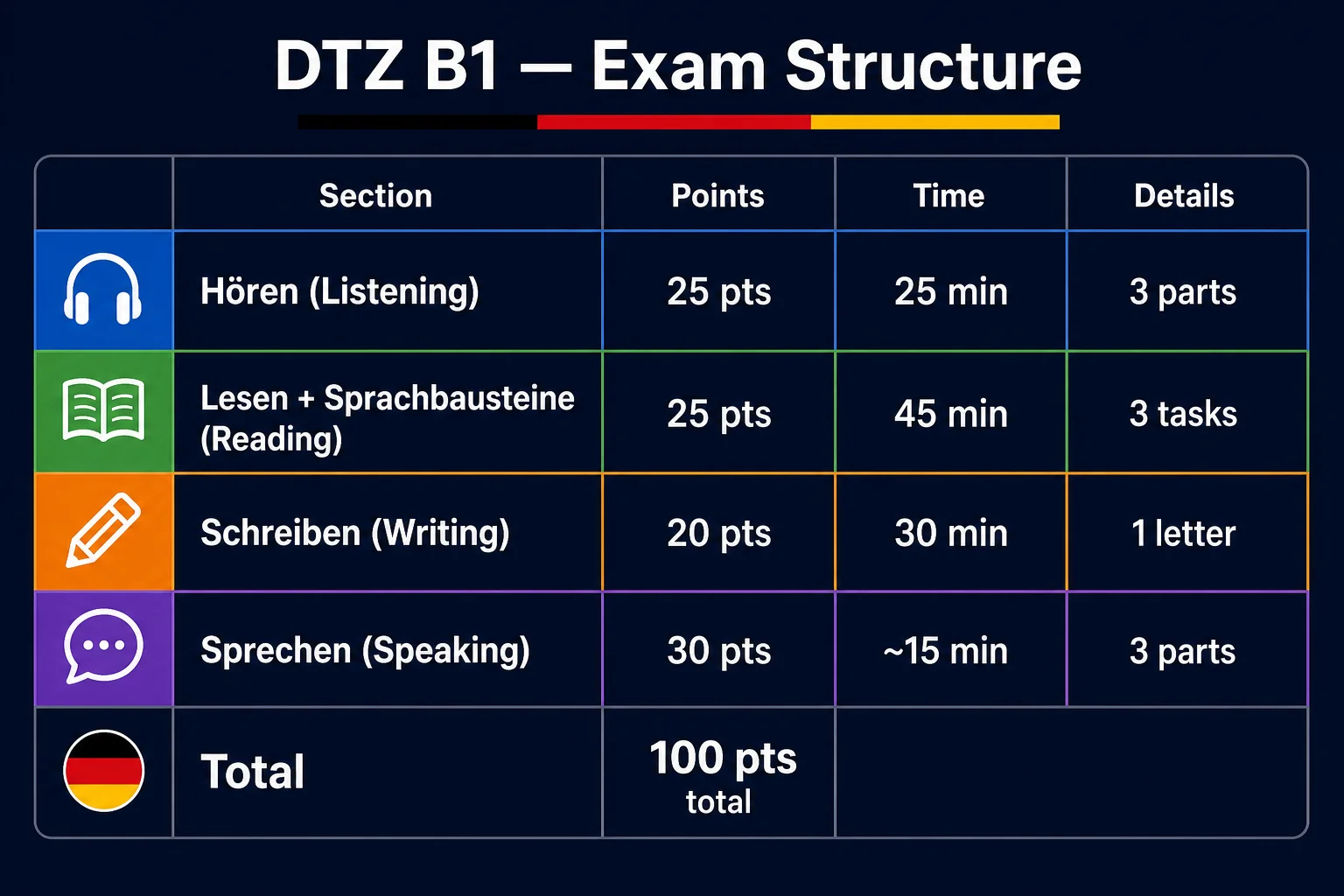
DTZ: four scored parts totalling 100 points — Hören, Lesen including Sprachbausteine, Schreiben, Sprechen.
| Part | Time | Points | What you do |
|---|---|---|---|
| Hören (Listening) | ~25 min | ~25 | Announcements, dialogues, longer monologues — de-DE / Hochdeutsch |
| Lesen (Reading + Sprachbausteine) | ~45 min | ~25 | Everyday texts + gap-fill grammar inside Lesen (not a fifth module) |
| Schreiben (Writing) | ~30 min | ~20 | One functional letter or email, ~80–100 words, required content points |
| Sprechen (Speaking) | ~15 min | ~30 | Paired: intro, topic monologue, joint planning |
| Total | Written ~100 min + oral | 100 | 60–100 B1 · 33–59 A2 · 0–32 no certificate |
Lesen — ~45 minutes, ~25 points (Sprachbausteine lives here)
Reading is one scored part, not two exams. You work through several everyday texts, then a gap-fill that Prep2Go (and most course teachers) call Sprachbausteine. That gap-fill is still Lesen — it does not get its own 25-point lane. Drill plan and letter skeletons: Sprachbausteine & Schreiben templates.
Texts stay inside integration life: Behörden, housing ads, work, health, school, mobility. Closed formats only — you mark an answer sheet; you do not write a free paragraph in Lesen.
Teil 1 — directories, menus, timetables
Short lookup texts: a Rathaus Wegweiser, a website menu, a Speisekarte, a Fahrplan. Multiple choice. The skill is selective reading — find the opening time, the right Amt, the platform — not a literary summary.
- Trap: the option that repeats a word from the text but answers a different question. Read the question stem first, then scan.
Teil 2 — Kleinanzeigen (matching)
Situations matched to ads: a flat, a job, a used bike, a Kita place. One situation often has no match (mark X). Abbreviations are the real test: 3 ZKDB, NK, WM, TZ, Vollzeit.
- Trap: matching on one shared noun (Wohnung, Job) and ignoring a deal-breaker (no pets, nights only, too far from the U-Bahn).
Teil 3 — short press and formal notices
Kurznachrichten, a Behördenbrief, a school or employer notice. Mix of true/false and multiple choice. You need the main point and one precise detail (deadline, who must act, what happens if you don’t).
Teil 4 — brochures and instructions
A Ratgeber, product leaflet, or safety note. Often true/false. Follow the instruction, not the vibe — “nur nach Rücksprache mit dem Arzt” is not the same as “you may always”.
Teil 5 — Sprachbausteine (gap-fill inside Lesen)
A short formal letter or notice with numbered gaps. For each gap you pick the word that fits grammar and meaning: articles and case after a preposition, connectors that send the verb to the end, verb+preposition chunks (warten auf, bitten um), a relative pronoun.
This is not a fifth equal module and it is not a separate 25-point grammar exam. It sits inside the Lesen total. Fastest method: read the whole letter once for sense, decide what the gap must mean, then look at the options. Options-first overthinking is how people pick a grammatically possible but context-wrong word.
| Gap type | What to check |
|---|---|
| weil / dass / obwohl / damit | Verb-final in the next clause |
| mit / bei / von / zu / für / ohne | Dativ vs Akkusativ after the preposition |
| der / die / das / dem / den | Gender + case in that slot |
| warten auf, sich freuen auf, sich bewerben um | Fixed verb + preposition — memorise as a chunk |
Hören — ~25 minutes, ~25 points
Hochdeutsch at natural speed: voicemail, station or workplace announcements, two-speaker dialogues about housing, health, or the Bürgeramt. Questions are on the paper before the audio. Clips play once or twice depending on the Teil — read the instruction line; do not assume every track repeats. Ear-training habits: DTZ Hören tips.
Teil 1 — short everyday clips
Standalone voicemails and PA spots. One or two questions each. You need the main message (who should call back? what changed?) and one detail (platform, room, time). Miss the first sentence and both items can go.
Teil 2 — dialogues
Two speakers negotiate something practical: a viewing, a reschedule, insurance. Questions ask who agrees, who refuses, what they decide. Track speakers from “Guten Tag, hier ist …” — wrong attribution is a full miss.
Teil 3 — longer monologues and Durchsagen
A longer single-speaker text: information broadcast, public-service message. Mix of gist (“what is the speaker advising?”) and detail (date, exception). Keyword-hunting without following the argument is the usual miss.
- Read the question stem in the pause — not all four options. Predict the type of answer (time, place, reason), then listen for that.
- Never leave a blank. Unanswered items score zero; a reasoned guess still has a chance.
- Train de-DE / Hochdeutsch. Classroom-slow audio and transcript-open study do not transfer to exam speed.
Schreiben — ~30 minutes, ~20 points
One letter or email, about 80–100 words. The prompt names the recipient (neighbour, company, Amt) and lists required content points — typically four. Missing a bullet costs more than a handful of grammar slips. This part is 20 of 100, not an equal quarter of the exam.
| What scorers look at | In practice |
|---|---|
| Task points | Every bullet on the prompt — tick them as you write |
| Register | Sie + formal close to an Amt or firm; du/ihr only if the prompt is clearly informal |
| Structure | Greeting, reason, details, request or offer, close |
| Language | Clear B1 sentences beat broken complex clauses |
Openings and closes that match Sie / du
- Formal: Sehr geehrte Damen und Herren, / Sehr geehrte Frau Müller, — close Mit freundlichen Grüßen
- Semi-formal neighbour: Liebe Frau Müller, — close Viele Grüße
- Reason line: ich schreibe Ihnen, weil … / ich möchte mich über … informieren.
- Request: Könnten Sie mir bitte …? / Ich bitte Sie freundlich, …
Reusable skeletons and a four-week drill: Sprachbausteine & Schreiben templates. Aim near 90 words so you cover the bullets without a novel.
Sprechen — ~15 minutes, ~30 points, paired
You sit with another candidate and two examiners. Three parts run back to back. This is the heaviest single block (~30 of 100). People who only drill letters leave the easiest B1 points on the table.
Part 1 — Sich vorstellen
Short questions: name, origin, how long in Germany, work or course, family, free time. Answer in 2–4 sentences. One-word replies waste grammar you already have.
Stronger: „Ich komme aus der Ukraine und wohne seit zwei Jahren in München. Ich arbeite in einem Restaurant, aber ich möchte später in meinem Beruf arbeiten. In der Freizeit lerne ich Deutsch und treffe Freunde.“
Part 2 — topic monologue
A card with a topic and a few bullets. Speak for about two minutes: cover the points, add one opinion or example. Typical themes: shopping, transport, neighbourhood, health, working in Germany.
Connectors that sound like B1 organisation: Zunächst … Außerdem … Ein wichtiger Punkt ist … Ich persönlich finde, dass …
Part 3 — Gemeinsam etwas planen
You and your partner plan something: a party, a day trip, a gift. Examiners watch interaction — propose, react, disagree politely, agree. A memorised monologue that ignores the partner scores worse than messy but real turn-taking.
- Suggest: Wie wäre es, wenn wir …? / Ich schlage vor, dass …
- Agree: Das ist eine gute Idee. / Ja, einverstanden.
- Disagree: Ich bin nicht sicher, ob das gut ist, weil … / Vielleicht wäre es besser, wenn …
- Ask: Was denkst du? / Wie findest du das?
- Close: Also, wir haben entschieden, dass … / Gut, dann machen wir das so.
How the 100-point total becomes A2 or B1
The DTZ does not require 60% in each part. There is no per-section pass mark of the CIPLE 25%-floor type. The certificate follows the total out of 100:
- 60–100 points → B1 certificate
- 33–59 points → A2 certificate
- 0–32 points → no certificate
Example from the overview: 12/25 Hören, 20/25 Lesen, 16/20 Schreiben, 25/30 Sprechen. Total = 73 → B1. The weak listening paper did not kill the sitting.
Soft nuance, not a second secret rule: for an overall B1 outcome, speaking still needs to look like B1 interaction — examiners are not printing B1 off a silent oral. Do not invent extra BAMF handbook floors on top of the 100-point total. If you want the scaled bands, the worked example, and the A2-outcome options, use the overview — What Happens if You Get A2.
If you get A2 — retakes are not a Goethe module shop
Landing 33–59 is an A2 certificate, not a blank fail — and it is not B1 proof for Einbürgerung. You need another sitting for B1. Retake rules vary by centre and by path. Do not plan on “resit only Schreiben” as a universal DTZ right — that modular retake is a Goethe B1 habit. Integration-course participants may have a Wiederholungsprüfung path through their Träger; private candidates usually rebook a full date. Details: What Happens if You Get A2.
DTZ vs Goethe-Zertifikat B1 vs telc Deutsch B1
All three are commonly accepted for Einbürgerung at B1. Pick by path, not by brand. Full decision tree: Germany naturalisation language certificate 2026.
| DTZ | Goethe-Zertifikat B1 | telc Deutsch B1 | |
|---|---|---|---|
| Citizenship (B1) | Commonly yes | Commonly yes | Commonly yes |
| Tied to Integrationskurs | Usual end exam | No | No |
| Dual level (A2 or B1) | Yes — total out of 100 | No — B1 only | No — B1 only |
| Sprachbausteine | Inside Lesen | No named section | Named written section on telc B1 |
| Speaking | Paired, ~15 min, ~30/100 | Usually paired | Usually paired |
| Per-skill floor | No — total decides | Modules scored separately (confirm Goethe) | Modules scored separately (confirm telc) |
| Typical fee band | IK often included; standalone centre-set (soft ~€100–180) | Soft ~€190–250 | Soft ~€120–180 |
| Travels outside Germany | Germany-focused | Strongest name abroad | Widely known in Europe |
Euro amounts are centre-set bands, not a tariff. If you only need Einbürgerung and you are already in an Integrationskurs, sitting the DTZ at the end is usually the practical paper. If you need a diploma that HR abroad already recognises, read the certificate guide before you pay twice.
Common traps on the DTZ paper
- Treating paired speaking as two monologues. Part 3 is scored as interaction. Ask, react, finish a plan.
- Skipping a Schreiben bullet. Four task points beat a prettier letter that answers three.
- Sie / du mix-ups. An Amt letter with du looks careless. A neighbour prompt with Sehr geehrte Damen und Herren looks copied.
- Verb-final after weil / dass / obwohl. Sprachbausteine and Schreiben both punish “… weil ich habe keine Zeit.”
- Spelling that hides the word. ss/ß, umlauts, and capital nouns. Examiners can read through small slips; they cannot award a word they cannot recognise.
- Studying Goethe module math. You are not chasing a per-skill floor. You are trying to clear 60 of 100 on this paper.
Frequently asked questions
What score do I need for DTZ B1? A total of 60–100 points out of 100. 33–59 is A2; 0–32 is no certificate. There is no official per-section pass mark.
Is DTZ speaking paired? Yes. You are examined with another candidate: introduction, a short topic talk, then joint planning — about 15–16 minutes, often on a different day from the written paper.
Can a weak section fail the whole DTZ? Not by a CIPLE-style floor. The total decides. A weak Hören paper can still sit inside a B1 total if Sprechen and the rest carry you over 60. Speaking still needs to support B1 descriptors in practice — see the overview for the worked example.
Where is Sprachbausteine? Inside Lesen (the gap-fill Teil of the reading paper), not a fifth equal-weight module. It shares the ~25 Lesen points.
Can I retake only one DTZ module? Do not count on it. Centre and course rules vary. Goethe B1 is the exam people remember for modular resits. On the DTZ, an A2 result means you still need another sitting for B1 proof — start from the overview section “What Happens if You Get A2.”
Is the DTZ the same as the Einbürgerungstest? No. DTZ is the language exam. Civic knowledge (Orientierungskurs / Leben in Deutschland, and the naturalisation civic test where it applies) is a separate requirement. Completing an Integrationskurs typically involves both the language exam and the civic path — confirm with BAMF and your Träger.
How long is the DTZ? Written about 100 minutes (Hören ~25, Lesen ~45, Schreiben ~30). Oral about 15–16 minutes, paired, often another day.
Is Einbürgerung a 10-year residency path? No. Standard naturalisation residency in Germany is 5 years (3 in exceptional cases). B1 German is the language floor. Portugal’s longer clock is a different country — do not mix the two files.
Blue Card → settlement → 5-year citizenship: Germany Blue Card to citizenship 2026. EU comparison: Europe language requirements 2026.
Next step
If the Teile are clear but you are unsure the total would clear 60, run a readiness check and use the DTZ B1 hub for skill practice. Keep scoring questions on the DTZ overview so this page stays the task map.
Related: DTZ overview (scoring & A2 outcome) · How to pass DTZ B1 · Which certificate? · Hören tactics · Sprachbausteine & Schreiben.
Official orientation: BAMF Integrationskurse · BAMF Abschlussprüfung · Goethe-Zertifikat B1 · telc German exams. Session rules and fees change — verify with your centre before you book.
Last updated August 2026. Point weights and A2/B1 bands follow Prep2Go’s DTZ canon (100-point total, B1 from 60). Always confirm the live sitting with your Träger or licensed centre.