

Quick Answer
DTZ for Einbürgerung & Niederlassungserlaubnis (2026): B1 pass rule (level outcomes, not one %), section timings, Sprachbausteine — then timed mock pack or Goethe/telc/ÖSD-theme deck for DTZ prep.
Germany requires at least B1 German for a permanent residence permit (Niederlassungserlaubnis) and for naturalisation (Einbürgerung). The DTZ — the Deutsch-Test für Zuwanderer — is the official gateway exam. Pass it and you hold documented proof that meets BAMF requirements. Fail to prepare properly and you may leave with only an A2 certificate, delaying your residency or citizenship timeline by months.
Here: how the 0–100 scale maps to A2 vs B1 (no per-section pass mark), what Hören, Lesen (with Sprachbausteine), Schreiben, and Sprechen test, a sample letter with notes, speaking prompts, an 8-week plan, and how to register — in an Integrationskurs or on your own.
Deciding whether DTZ, Goethe B1, or telc fits your citizenship file? Read Germany naturalisation 2026: which language certificate? — then use this article for DTZ mechanics.
What is the DTZ?
The Deutsch-Test für Zuwanderer (DTZ) is the standardised language examination that concludes BAMF-funded integration courses in Germany. It is jointly developed by the Goethe-Institut and telc GmbH under mandate from the Bundesamt für Migration und Flüchtlinge (BAMF). You do not have to be enrolled in an integration course to take it — the test is open to any adult learner.
What makes the DTZ different from the standard Goethe-Zertifikat B1 or telc Deutsch B1 is its dual-outcome design: every candidate receives a certificate, either at A2 or at B1, depending on their total score. There is no such thing as a blank fail — but there is a meaningful difference between the two outcomes when it comes to residence law.
Why B1 (Not A2) Matters for Your Residence Status
Under German residence law (§ 9 AufenthG) a permanent residence permit generally requires B1. Naturalisation under the Staatsangehörigkeitsgesetz also requires B1. An A2 certificate from the DTZ demonstrates progress, but it is not sufficient for either pathway. It will, however, satisfy some shorter-stay visa renewals and confirm participation in your integration course.
| Certificate | Score required | Opens |
|---|---|---|
| DTZ A2 | 33–59 points | Course completion, some visa renewals |
| DTZ B1 | 60–100 points | Permanent residence permit, naturalisation, BAMF course exemption for future learners |
Exam Structure at a Glance
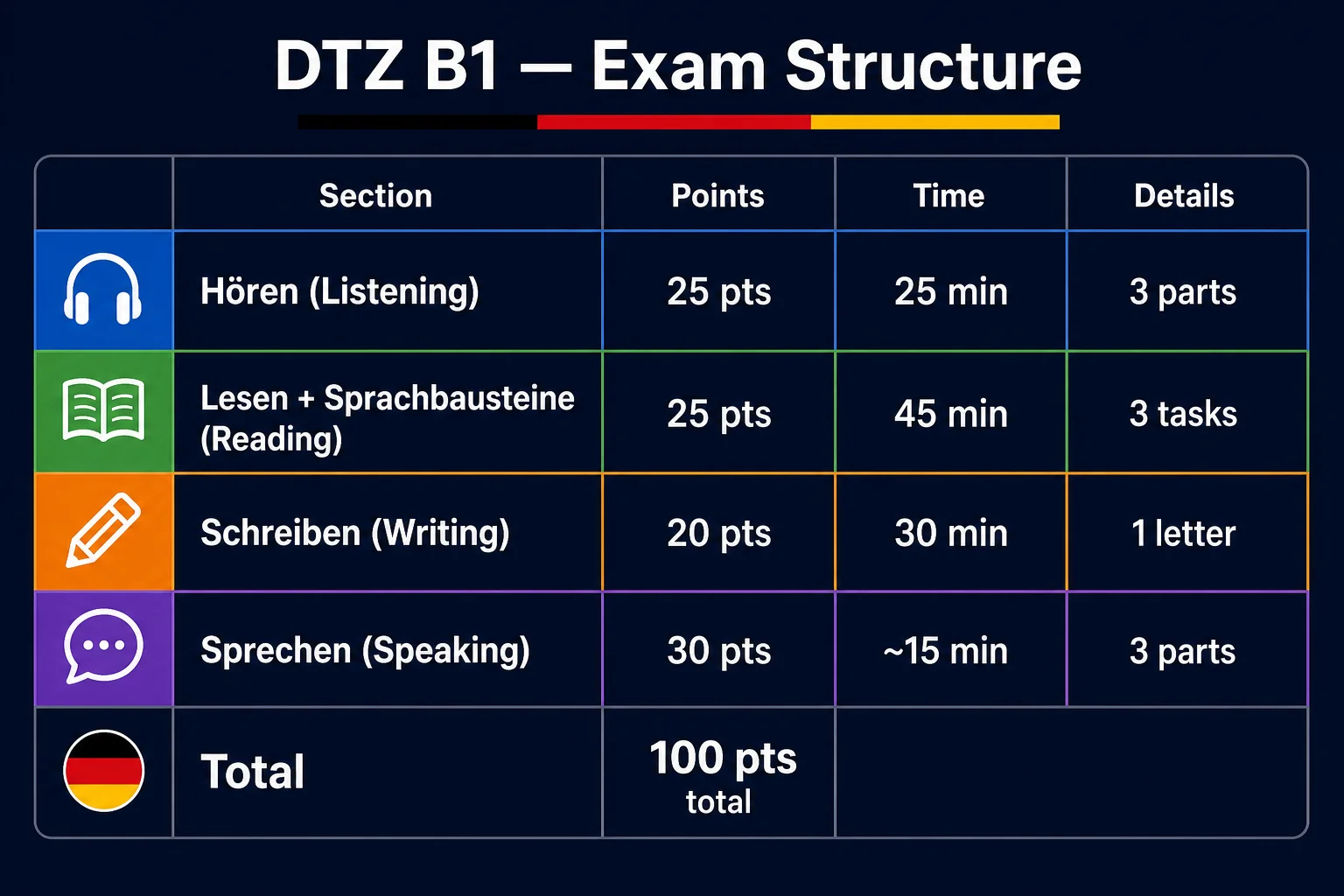
DTZ B1: four scored parts (100 points) — Hören, Lesen incl. Sprachbausteine, Schreiben, Sprechen.
The DTZ has two separate parts, typically held on different days. The written part lasts 100 minutes; the oral part approximately 15–16 minutes.
| Section | Time | Points | Skill tested |
|---|---|---|---|
| Listening (Hören) | 25 min | 25 | Everyday conversations, announcements, phone calls |
| Reading + Sprachbausteine (Lesen) | 45 min | 25 | Text comprehension + gap-fill grammar |
| Writing (Schreiben) | 30 min | 20 | Functional letter or email (80–100 words) |
| Speaking (Sprechen) | ~15 min | 30 | Self-introduction, monologue, joint planning |
| Total | ~2.5 hrs over 2 days | 100 | — |
Speaking carries the single largest weight — 30 points. Most candidates underestimate this and over-invest in writing. The oral exam is where B1 is won or lost.
The Scaled Scoring System — How B1 Is Actually Awarded
This is the part most guides explain poorly. The DTZ does not require you to pass each section separately. There are no individual section minimums. The only threshold that matters is your total out of 100:
- 60–100 points → B1 certificate
- 33–59 points → A2 certificate
- 0–32 points → no certificate issued (exam not passed)
Example: you score 12/25 on listening (below what you feared), 20/25 on reading, 16/20 on writing, and 25/30 on speaking. Total = 73 → B1. A weak section does not disqualify you as long as the total clears 60.
The practical implication: target your strongest skills first. If speaking is your strength, invest in it — those 30 points are your safest path to 60.
Section 1 — Listening (Hören): 25 Points, 25 Minutes
The listening section includes three task types built around everyday German life scenarios: phone messages, short announcements (train station, workplace), and longer two-person conversations about practical topics (housing, health, authorities).
Each recording plays once or twice — the number depends on task type. You receive the questions before the recording plays, so you can scan them in advance. This is the single most important technique for this section.
What examiners are testing
- Identifying the main point of a conversation or announcement
- Distinguishing specific details (times, places, names, numbers)
- Understanding polite requests, complaints, and instructions in authentic Hochdeutsch
Practical tips
- Read questions before the audio starts — every time, without exception
- Circle one answer as soon as you hear it; refine only if the recording repeats
- Train with authentic material: ARD Mediathek, DW für Anfänger, Nicos Weg (Goethe-Institut free series)
- Never leave an answer blank — unanswered questions score zero, a guess scores 0.25 in expectation
Section 2 — Reading + Sprachbausteine (Lesen): 25 Points, 45 Minutes
Reading has two sub-parts that candidates often confuse: a straight text comprehension set and the Sprachbausteine — a gap-fill grammar task embedded inside a realistic document (a letter, an email, a notice).
Text comprehension (Leseverstehen)
You read practical texts — a classified ad, a short newspaper item, a letter from an authority — and answer comprehension questions. The vocabulary is everyday B1: housing, health, work, school. Questions test whether you understood the main point and specific details, not whether you can define obscure words.
Sprachbausteine — what it actually is
Sprachbausteine (literally "language building blocks") presents a short functional text — usually a semi-formal letter or an announcement — with numbered gaps. For each gap you choose the correct connector, preposition, or verb form from a list of options. It is not a traditional grammar drill. The skill tested is choosing the grammatically and contextually appropriate word — the kind of judgment you develop by reading and writing real German, not by memorising tables.
Common gap types:
| Gap category | Example | What to know |
|---|---|---|
| Konnektoren | weil, obwohl, damit, trotzdem | Subordinating vs. coordinating; word order shift after weil/dass/wenn |
| Verben mit Präpositionen | warten auf (+ Akkusativ), bitten um | These must be memorised in chunks, not rules |
| Modalverben | müssen, dürfen, sollen, können | Meaning differences in formal contexts (sollen = obligation from third party) |
| Kasusformen | dem/den/der after prepositions | Dativ after mit/bei/von/zu/seit/nach; Akkusativ after für/durch/gegen/ohne |
| Zeitform | Perfekt vs. Präteritum | Haben vs. sein as auxiliary; strong verb Partizip II forms |
The fastest way to improve Sprachbausteine is to read the full text first, decide the meaning of each gap from context, then look at options. Do not read the options first — that leads to overthinking.
Section 3 — Writing (Schreiben): 20 Points, 30 Minutes
You write one letter or email of 80–100 words, responding to a prompt that specifies the recipient (a neighbour, a company, an authority), the situation, and four required content points you must address. Missing even one content point costs marks — typically more than a few grammar errors.
How points are allocated
| Criterion | Weight |
|---|---|
| Content — all four points addressed | High (~40% of writing score) |
| Structure — greeting, opening, body, closing | Medium |
| Grammar and vocabulary | Medium |
| Fluency and coherence | Medium |
Sample letter with annotations
Task: Your neighbour's dog barks every night. Write to your neighbour: (1) describe the problem, (2) explain how it affects you, (3) make a polite request, (4) suggest a solution.
Liebe Frau Müller,
ich schreibe Ihnen, weil Ihr Hund jede Nacht sehr laut bellt. ← (1) problem stated
Das ist ein großes Problem für mich, weil ich schlecht schlafen kann und morgens sehr müde bin. ← (2) impact on you
Ich bitte Sie freundlich, das Problem zu lösen. ← (3) polite request
Vielleicht könnte der Hund nachts drinnen bleiben? ← (4) solution suggested
Viele Grüße,
Anna Schmidt
Word count: 81. All four points covered. Simple sentence structures that are correct rather than complex structures with errors — exactly the right approach.
Key rules for the writing section
- Formal recipient (company, authority): start with "Sehr geehrte Damen und Herren" or "Sehr geehrte Frau / Herr [Name]"; close with "Mit freundlichen Grüßen"
- Informal recipient (neighbour, friend of a friend): "Liebe/r [Name]"; close with "Viele Grüße" or "Herzliche Grüße"
- Never abbreviate: write out Ich, nicht, dass — examiners note sloppy shortcuts
- Aim for 90 words — this gives a small buffer without risk of being penalised for going over
- Do not skip a content point to save time — one missing point costs more than five grammar errors
Section 4 — Speaking (Sprechen): 30 Points, ~15 Minutes
Speaking is a pair examination: you and one other candidate sit with two examiners. The three parts follow one another without a long pause.
Part 1 — Sich vorstellen (introducing yourself)
Examiner asks short questions about you: name, origin, how long in Germany, work or study, family, hobbies. Keep answers to 2–4 sentences. Avoid one-word answers — every answer is an opportunity to demonstrate grammar.
Strong answer: "Ich komme aus der Ukraine und wohne seit zwei Jahren in München. Ich arbeite als Köchin in einem Restaurant, aber ich möchte gerne in meinem Beruf als Ingenieurin arbeiten. In meiner Freizeit lese ich viel und lerne Deutsch."
Weak answer: "Ich komme aus Ukraine. Ich bin Köchin." — technically correct but too short; no connectors, no grammar variety.
Part 2 — Über ein Thema sprechen (topic monologue)
You receive a card with a topic and 3–5 bullet points. You speak freely for about 2 minutes, covering the points and sharing your own opinion or experience. Common topics: online shopping, public transport, neighbourhood life, health and sport, working in Germany.
Structure your answer with connectors: "Zunächst möchte ich sagen… Außerdem… Ein wichtiger Punkt ist… Ich persönlich finde, dass…" — this alone raises your score by demonstrating B1-level language organisation.
Part 3 — Gemeinsam etwas planen (joint planning)
You and your exam partner plan something together — a welcome party, a day trip, a farewell gift for a colleague. The examiners observe how you interact: do you propose ideas, respond to your partner, negotiate, agree, and reach a conclusion?
Useful phrases for Part 3:
- Making a suggestion: "Wie wäre es, wenn wir…?" / "Ich schlage vor, dass…"
- Agreeing: "Das ist eine gute Idee." / "Ja, einverstanden." / "Das finde ich auch gut."
- Disagreeing politely: "Ich bin nicht sicher, ob das eine gute Idee ist, weil…" / "Vielleicht wäre es besser, wenn…"
- Asking for your partner's opinion: "Was denkst du darüber?" / "Wie findest du das?"
- Reaching agreement: "Also, wir haben entschieden, dass…" / "Gut, dann machen wir das so."
The examiners want to see communication, not a perfect monologue. Interrupt politely, ask follow-up questions, and respond to what your partner actually says — not to a memorised script.
DTZ vs. Goethe B1 vs. telc Deutsch B1: Which Is Right for You?
| Feature | DTZ | Goethe-Zertifikat B1 | telc Deutsch B1 |
|---|---|---|---|
| Audience | Integration course participants & immigrants | General / international | General / professional |
| Topics | Everyday immigration life (authorities, housing, health) | Broad cultural and social topics | Broad, some professional |
| Scoring | Scaled: A2 or B1 from one exam | B1 only; fail is a fail | B1 only; fail is a fail |
| Section minimum required? | No — total score only | No (but speaking must pass) | Yes — each module separately |
| Fee (approx.) | ~€100 (often covered by integration course) | ~€150–180 | ~€120–160 |
| Accepted for residence / naturalisation | Yes (primary pathway) | Yes | Yes |
| Accepted internationally / for study | Germany only (integration context) | Worldwide | Widely in Europe |
If your goal is German residence or naturalisation: the DTZ is the most practical and cost-effective path. If you also need a certificate for jobs abroad or university admissions outside Germany, consider the Goethe-Zertifikat B1 as a supplement.
8-Week Study Plan
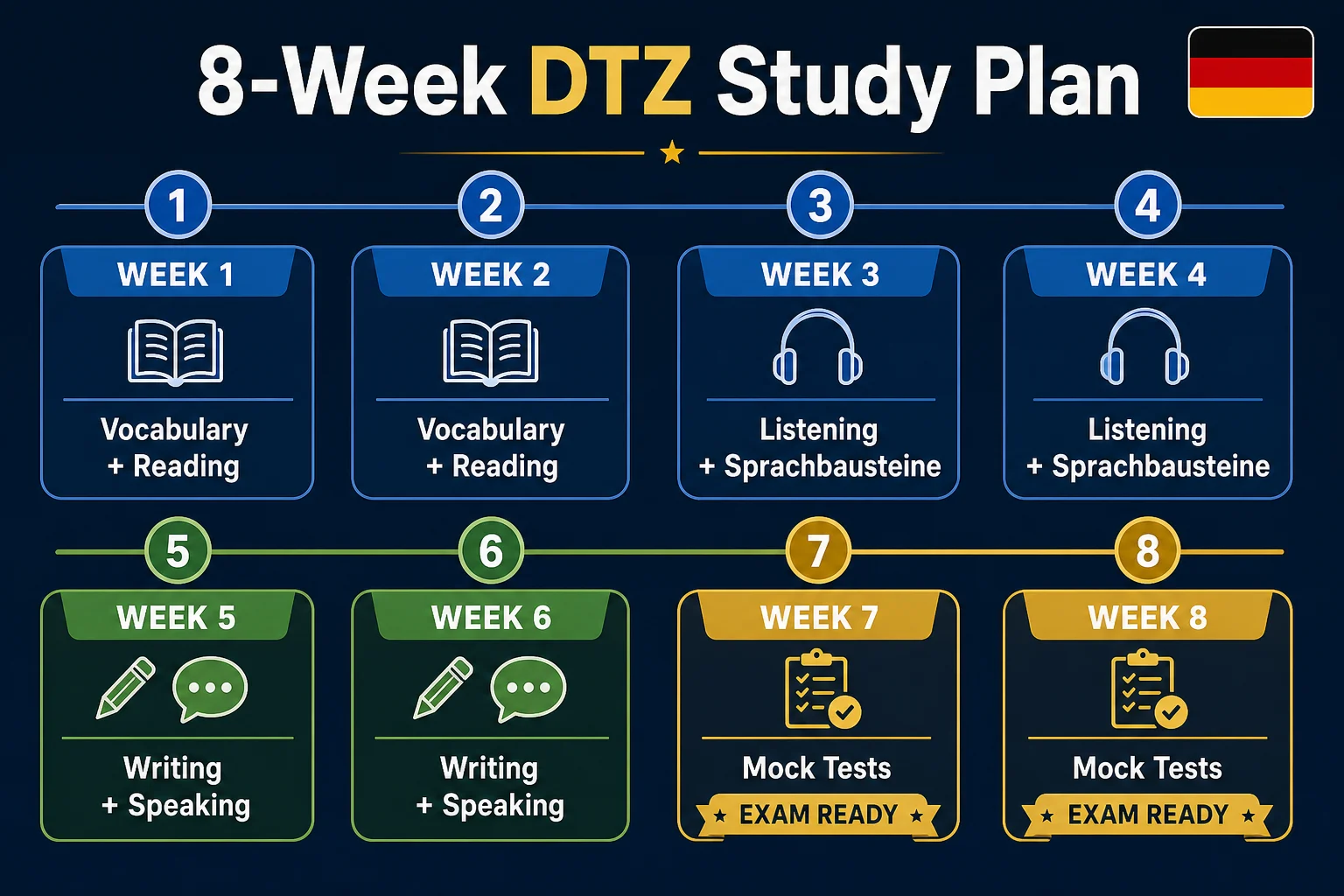
8-week DTZ B1 study plan: vocabulary → listening → writing/speaking → mock tests.
This plan assumes roughly 60–90 minutes of focused study per day, five days a week. Adjust to your starting level — if you are currently at A2+, compress Weeks 1–2 into one.
Weeks 1–2: Foundations — vocabulary and reading fluency
- Work through the 500 most frequent DTZ vocabulary items (housing, health, work, authorities, school, transport) — use spaced repetition, not lists
- Read one short German text per day: a newspaper notice, a rental listing, a letter from an insurance company
- Identify your weakest grammar area (modal verbs, cases, Perfekt) and focus 15 min per day on it
Weeks 3–4: Section drills — listening and Sprachbausteine
- Complete two DTZ listening exercises per session — always read questions first, then listen
- Practise 3 Sprachbausteine tasks per week — read the full text before looking at the options
- Begin speaking practice: record 60-second answers to self-introduction questions, listen back, note errors
Weeks 5–6: Writing and speaking fluency
- Write one DTZ-format letter per session (timed: 30 minutes exactly); cover all four content points every time
- Memorise your formal/informal greeting and closing formulas — these are zero-effort points
- Practice Part 2 and Part 3 speaking with a partner, language exchange (Tandem, HelloTalk), Talkio for solo AI drills, or a local integration course group
Weeks 7–8: Full mock tests and targeted fixes
- Complete 2–3 full written mock tests under timed conditions — no phone, no dictionary
- Score each section; identify the lowest and put extra time there in the final week
- Do at least two full speaking simulations with a partner — not just rehearsing answers, but actually responding to unexpected questions
- Day before the written exam: light review, no new material, normal sleep (7–8 hours)
How to Register
If you are in an integration course
The exam is included in your integration course costs. Your Kursträger (course provider) registers you automatically at the end of the language module (B1 level). The exam fee (~€100) is covered by BAMF for eligible participants. You are entitled to one free retake if you do not achieve B1 on the first attempt — this includes 300 additional course hours.
If you are registering independently (without a course)
- Go to telc.net → "Prüfungstermine" → filter by DTZ, your city, and your preferred date
- Or use the Goethe-Institut test centre finder for your region
- Fee for private candidates: approximately €95–115 depending on test centre; you pay directly
- Bring valid ID (passport or Aufenthaltstitel) on exam day — no exceptions
- Results are issued within 2–4 weeks; the certificate arrives by post or via your test centre
2026 availability
The DTZ is available year-round at telc and Goethe-Institut test centres across Germany. Integration course cohorts typically sit the exam at course completion — this varies by provider. Book at least 4–6 weeks in advance; popular urban centres (Berlin, Munich, Hamburg, Frankfurt) fill up quickly.
What Happens if You Get A2 Instead of B1?
Scoring 33–59 points gives you an A2 certificate. This is not a blank fail — it is official documentation. But it does not satisfy B1 residency requirements. Your options:
- Integration course participants: one free retake after 300 additional course hours (the "Wiederholungsprüfung")
- Private candidates: rebook and repay; no restriction on number of attempts
- Request your score breakdown from the test centre — they are required to provide it. Use it to identify exactly which section cost you the most points
- If you scored 55–59: you are very close — targeted 4–6 week preparation on your weakest section is usually enough
6 Mistakes That Fail Prepared Candidates
1. Neglecting the speaking section
Speaking is 30 of 100 points — the heaviest single block. Many candidates over-drill Schreiben (20 points) and under-rehearse Sprechen. If you already speak B1 in daily life, a focused week on the three oral tasks can lift the total more than another grammar worksheet.
2. Missing a content point in the letter
The writing task specifies four points. Missing one costs disproportionately. Many candidates write a beautiful letter that addresses only three of the four points because they ran out of time or misread the task. Always tick off each point mentally as you write.
3. Reading listening options before scanning questions
Most candidates read the answer options first and try to match them to what they hear. This creates cognitive overload. Read the question (not the options), predict the type of answer expected, then listen for that.
4. Translating in their head during speaking
Candidates who think in their native language and translate live lose fluency and make unnatural errors. Train to think in German phrases, not sentences. Learn fixed expressions for common situations so your brain has German-ready chunks to reach for.
5. Over-correcting Sprachbausteine
Sprachbausteine gaps are decided by context, not by grammar rules alone. Candidates who apply rules mechanically ("weil always goes to end of clause") often pick grammatically possible but contextually wrong options. Read the sentence for meaning first.
6. Arriving unprepared for the pair dynamic in speaking
The Part 3 pair discussion is not a monologue. Candidates who rehearse their own speech but never practise responding to an unexpected idea from a partner often freeze or ignore their partner entirely. Examiners explicitly assess interaction quality.
Frequently Asked Questions
Does the DTZ replace the Goethe-Zertifikat B1?
For German residence and naturalisation purposes: yes, the DTZ B1 is fully equivalent. For international recognition (study abroad, jobs outside Germany), the Goethe-Zertifikat has broader acceptance. The DTZ is Germany-specific by design.
Can I take the DTZ without attending an integration course?
Yes. The DTZ is offered as an open exam at telc and Goethe-Institut test centres. You pay the fee directly (~€100) and book independently. You do not need a BAMF integration course certificate to register.
How long is the DTZ B1 certificate valid?
The DTZ certificate does not have a formal expiry date — it is a record of achievement at the time of the exam. However, for naturalisation, the Ausländerbehörde may request that proof of B1 is recent (some offices consider certificates older than 4–5 years to be outdated). When in doubt, check with your local authority.
What is the pass rate for the DTZ?
BAMF does not publish official pass rates for the DTZ. Outcomes vary widely by course completion, prior German exposure, and whether you train under timed exam conditions. The most reliable predictor of B1 success is consistent mock practice — not total hours of study.
Is the speaking exam done alone or with a partner?
Always with a partner (a pair examination). If an odd number of candidates are scheduled, one group of three may be formed for Part 3. The examiners assess each candidate individually — your partner's performance does not affect your score.
Can I use a dictionary in the writing section?
No. No dictionaries or reference materials are permitted in any part of the DTZ written or oral exam.
Practise with Prep2Go
Prep2Go mirrors the real DTZ layout: de-DE listening, Lesen + Sprachbausteine, timed Schreiben, and speaking with B1 sample answers.
- DTZ mock test — exam-format timing; start without an account
- DTZ vocab deck (Goethe/telc/ÖSD themes) — DTZ for citizenship · covers Goethe/telc/ÖSD themes used in DTZ prep
- German A2–B1 grammar guide — cases, Perfekt, connectors, Sprachbausteine patterns
- DTZ B1 hub — all sections, speaking samples, study path
Last updated: May 2026. Confirm fees and session dates with your Kursanbieter or telc centre before registering.