
The Method Behind Exam-Ready Practice
Prep2Go is not a language app. It's a structured preparation system built around one goal: passing a specific exam on a specific date.
Exam-only practice — not language learning
Duolingo teaches you to have conversations. Prep2Go trains you for a specific test with specific rules: timed sections, strict word counts, background-noise audio, and section-specific pass thresholds.
Every exercise in Prep2Go maps directly to an actual exam task. There are no grammar lessons on topics that won't appear on the test. No conversational practice about hobbies. Every minute you spend on the platform is a minute spent preparing for what you'll actually face on exam day.
Candidates who study with general language apps often feel prepared — and then fail because they've never practiced under real exam conditions: time pressure, two-shot audio, strict format requirements. Prep2Go removes that gap.
See the full comparison — Prep2Go vs exam courses (LEPO, A por el DELE), mock test sites (CipleOnline.pt), language apps (Duolingo, Babbel), and private tutors — on the compare page.
Why 30–45 minutes a day beats cramming
Memory research consistently shows that short, frequent practice sessions produce better long-term retention than long, infrequent ones. This is the principle of spaced repetition: reviewing material at increasing intervals strengthens recall far more effectively than massed study.
30–45 minutes of daily practice is enough to move through vocabulary, complete listening exercises, and reinforce writing templates — all in a session that fits into a commute or lunch break. Skipping days and compensating with long weekend sessions is the most common reason candidates feel unprepared despite having spent the same total hours.
One vocabulary set. One skill exercise (reading, listening, writing, or speaking). One progress check. That's it. The plan handles the sequencing — you just show up.
Your exam date drives everything
When you start, you enter two things: your exam date and how many minutes per day you can study. The system builds a day-by-day plan that works backwards from that date, distributing practice across all four sections (Reading, Listening, Writing, Speaking) in proportion to how much each contributes to your score.
- 📅
Enter exam date + daily time available
The system calculates how many total practice sessions you have before the exam and what needs to be covered in each.
- 🗓️
Day-by-day roadmap is generated
Each day has a defined task. Nothing is left to chance — there's no "what should I do today?" decision fatigue.
- 📊
Plan adapts as you progress
If you're consistently strong in reading but weak in listening, the plan automatically shifts more time toward listening in the remaining weeks.
- ⚠️
Early warning if timeline is too short
If you register with 3 weeks left and a baseline diagnostic shows you're far below passing, the system will tell you before you waste money on the exam.
Score Readiness: the 25% trap
CIPLE, DELE, DELF, and CELI all share the same rule: you must reach a minimum score in each section individually — not just in the overall total. A candidate with strong reading and writing can fail the exam on listening alone, even if their total score would otherwise pass.
Score Readiness tracks each section separately and shows you exactly where you stand before you spend €72–85 on the exam. If any section is below the pass threshold, you see a clear warning — not after the exam, but while you still have time to fix it.
Candidate scores 72% in Reading & Writing, 65% in Speaking — but 23% in Listening. Overall average: 54%. Result: FAIL, because Listening fell below the 25% section minimum. Prep2Go flags this in practice before it happens at the real exam.
The platform shows this dashboard in real time as you practice. You decide when you're ready to book the exam — not the other way around.

AI writing feedback — and how speaking practice works
After you submit a written response, AI evaluates it using the same scoring dimensions that real CAPLE, Instituto Cervantes, Alliance Française, and University of Perugia examiners apply: task completion, vocabulary range, grammatical accuracy, and — critically — word count compliance.
- Task completion: All required information included (name, age, profession, preference, budget).
- Vocabulary: Appropriate for A2. "Prefiro" and "apartamentos" show good range.
- Word count: 38 words — 3 over the maximum. Real exam may deduct points. Shorten one sentence.
- Grammar: Correct use of verb forms. No critical errors.
You get writing feedback within seconds, at any hour. No waiting for a teacher to respond. No appointment needed. Speaking: in every full mock test, the oral section is included and AI-scored. For extra daily conversation drills between Prep2Go sessions, we also recommend Talkio (AI speaking) or human tutors via iTalki — both are separate products with their own pricing.
Train your speaking
Between Prep2Go sessions, practise out loud with Talkio — AI conversation when you cannot book a tutor or find a partner.
Link: https://www.talkio.ai?via=prep2go
Promo code PREP2GO — 15% off on all payments
After every practice session, clients see concrete scores (writing and mock-speaking: in-app AI; standalone speaking: after tutor sessions) and updated section readiness. They can share the progress dashboard with you — or you can direct them to continue based on the readiness score before scheduling the exam booking.
Start with a full mock test
Before building a study plan, every candidate takes a full mock exam — under real conditions: timed sections, exam-format audio, strict word counts. This diagnostic serves two purposes.
First, it sets an honest baseline. You find out exactly which sections need the most work before you start, not halfway through your preparation. Second, it makes the real exam feel familiar. Candidates who have done multiple mock tests under realistic conditions report significantly less anxiety on exam day.
- 🎯
Mock test → honest baseline
See your actual section scores before starting. The plan is built around your weak points, not an assumed average.
- 🔄
Repeat mock tests through preparation
Use the mock report pack for timed re-tests. Each run shows progress and resets the section readiness calculation.
- ✅
Final mock before booking the exam
Pass the mock test under exam conditions before spending money on the real one. If Score Readiness shows green across all sections — you're ready.
The Prep2Go toolkit: how each part gets you exam-ready
Everything on the platform is built for one outcome: passing your exam. Here’s what you use every day — the principles above in practice. Each block maps to the real test.
Learning Path
You enter your exam date and how many minutes per day you can study (e.g. 20, 30, 45). The system works backwards from the exam and builds a day-by-day roadmap: each day shows a fixed set of tasks — e.g. “Review 12 vocabulary cards”, “Complete Reading exercise 7”, “Complete Listening exercise 4” — so you never wonder what to do next. The plan distributes work across all four sections in line with exam weights (e.g. CIPLE: 45% Reading & Writing, 30% Listening, 25% Speaking). In the last 1–2 weeks before the exam, the path shifts to revision and full mock tests. If you skip days, the dashboard shows backlog; if your baseline mock shows a section far below pass, you get an early warning that the timeline may be too short. Daily email reminders (optional) nudge you to complete today’s lesson.
Why partners recommend this: “Complete today’s lesson” is actionable; “study Portuguese” is not. Lawyers and agencies can direct clients to the plan and track completion. Candidates who follow the path have a clear route to the test and fewer drop-offs.

Why: Principle 2, Principle 3
Vocabulary
1,000+ words aligned with the official exam themes (e.g. for CIPLE: housing, work, health, transport, shopping, food, family, free time, travel, services, education, culture). Each card includes the word, translation, native-speaker audio (European Portuguese for CIPLE, so pronunciation matches the exam), an example sentence in the target language and in English, and optional images. Cards are organised by theme and difficulty; you can filter by “not yet learned”, “learning”, “learned” and track progress. Spaced repetition schedules reviews so you see words again just when you’re about to forget them — no random lists. The set is drawn from real exam materials and high-frequency lists used by exam bodies; there is no filler vocabulary. You learn exactly what appears in reading and listening tasks and what you need for writing and speaking.
Why partners recommend this: Vocabulary is the bottleneck for most candidates. Prep2Go gives a closed, exam-relevant list with audio and structure — so users stop asking “what words do I need?” and start learning them. European Portuguese audio for CIPLE avoids the mismatch that happens when learners train on Brazilian sources.

Why: Principle 1
Skill exercises: Reading, Listening, Writing, Speaking
Every exercise mirrors a real exam task. Reading: short texts (ads, notices, emails, simple articles) with comprehension questions — same formats and lengths as the test; you answer and get immediate correct/incorrect feedback. Listening: audio played once or twice (as in the real exam), often with background noise (café, street, station) so you get used to non-studio conditions; questions match official task types (multiple choice, short answer, gap fill). Writing: timed prompts with strict word counts (e.g. CIPLE: 25–35 words for one task, 60–80 for the other); you type your answer and submit; AI returns a score and feedback on task completion, vocabulary, grammar, and word count (over/under is flagged so you fix it before the real exam). Speaking: in mock tests, the full oral section is recorded and AI-scored. Standalone speaking practice (daily scenarios) uses prompts and recording in the app; feedback is via our tutor network (e.g. iTalki), paid separately. All exercises feed into the Learning Path (so today’s lesson can say “do Reading 7”) and into Score Readiness, so you see which section is above or below the pass threshold.
Why partners recommend this: General apps don’t enforce word limits, two-shot audio, or section minimums. Prep2Go does. Practice here matches exam conditions — so the real test feels familiar and anxiety drops.

Why: Principle 1, Principle 5
Mock tests
Full-length exam simulators: same structure, section order, timing, and weights as the real test (e.g. CIPLE: Reading & Writing 75 min, Listening 30 min, Speaking 10–15 min; 55% overall, min 25% per section). You move through sections in order with a per-section timer; you cannot go back to previous sections. Reading and listening use exam-style tasks from the platform bank; writing has the same word-count rules and is scored by AI; the full speaking section is included and AI-scored in every mock. At the end you get pass/fail, overall percentage, and a breakdown per section with a clear view of which sections meet or miss the minimum. Use the first mock as a baseline before building your plan; repeat mocks during preparation to track progress; take a final mock shortly before booking the real exam. If Score Readiness is green across all sections, you’re ready to pay for the test (e.g. €72–85 for CIPLE). Subscription tiers include a set number of full mock runs (e.g. 3, 6, 12, or more for lifetime).
Why partners recommend this: Doing several full mocks under real conditions reduces exam-day anxiety and surprises. It’s the only way to know you’re ready before spending money on the real exam.

Why: Principle 6
Video Lab
A curated library of videos (e.g. YouTube) grouped by theme and level — e.g. daily life, numbers and prices, directions, shopping, health, work. Each video is chosen for clarity, speed, and relevance to exam topics; you watch inside the platform with optional subtitles and mark progress (e.g. “watched”). Video Lab trains your ear on real accents, natural speed, and varied contexts — the step between “I understand the exercise audio” and “I understand real speech.” Use it to reinforce vocabulary in context and to build confidence before the two-shot listening section. It complements the structured listening exercises rather than replacing them; many candidates use it 1–2 times per week as extra exposure.
Why partners recommend this: Listening is often the hardest section. Video Lab gives structured, exam-relevant exposure so candidates improve recognition and reduce anxiety before the real exam audio.
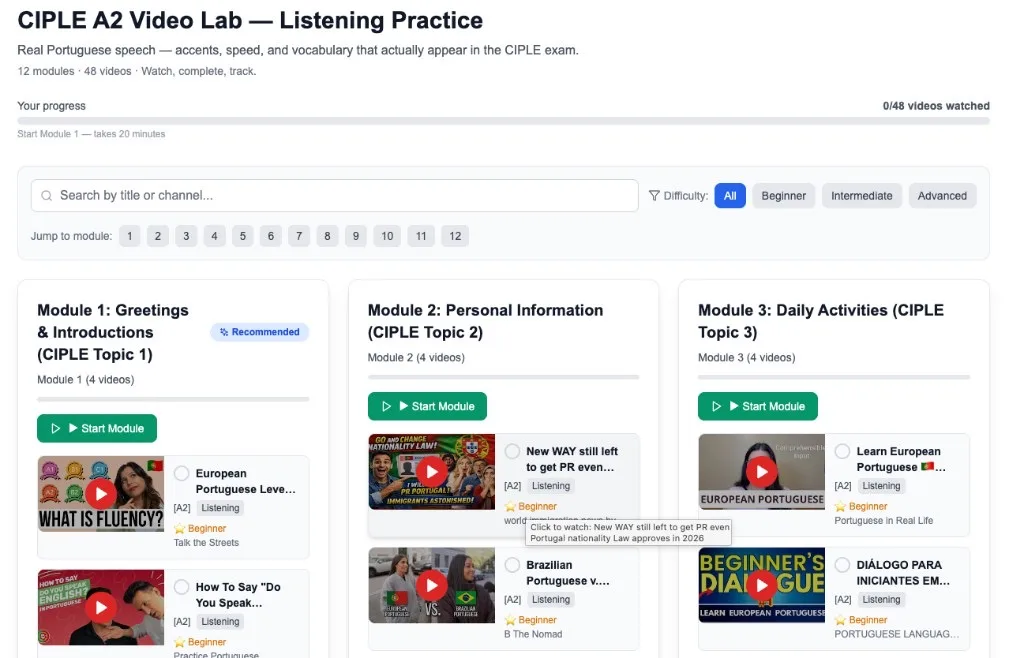
Why: Principle 1 (listening in real conditions)
Learning Path tells you what to do each day. Vocabulary, skill exercises, mock tests, and Video Lab are the building blocks. Score Readiness shows when you’re ready to book the exam. Everything is designed so that by exam day you’ve already practised under real conditions — and you pass.
Ready to start — or recommend to clients?
Readiness checks, vocabulary gap repair, and guided practice for candidates preparing toward a real exam date.
Or learn how the partner program works for lawyers and agencies.