

B2 is a different kind of challenge from A2. You're not learning survival phrases — you're learning to argue, to nuance, to discuss abstract ideas clearly and coherently. The DELF B2 doesn't test whether you can order a coffee. It tests whether you can defend a position under pressure, write a structured essay, and understand a French radio debate.
That gap between knowing French words and performing at B2 is not mysterious. It's a specific set of structures — the subjunctive, complex connectors, the conditional, passive constructions, discourse management — layered on top of solid B1 foundations.
B2 structures below — each section maps to what DELF B2 marks. Every section connects directly to what the DELF B2 tests. Read it as a map of B2 French, and use each section as a reference when something isn't clicking.

B2 French grammar for DELF: subjunctive, conditional, passé composé, nominalisation, connectors, colours, and a model essay.
Table of Contents
- How B2 French Works: The Logic of the Level
- Articles, Gender, and Agreement at B2
- The Subjunctive: When and Why
- The Conditional: Politeness, Hypothesis, Journalistic Conditional
- Tenses at B2: The Full Picture
- Multi-Meaning Verbs: One Word, Many Uses
- Modal and Semi-Modal Constructions
- Passive Voice: When the Action Matters More Than the Actor
- Nominalisation at B2: Abstract Register
- Building B2 Sentences: Complexity and Nuance
- Discourse Connectors: The Language of Argument
- Pronouns at B2: Relative, Demonstrative, Indefinite
- Numbers, Time, Statistics — Reading Data in French
- Directions and Spatial Language at B2
- Colours in French: Basic, Nuanced, and Idiomatic
- 50 Verbs for DELF B2 Topics
- Writing Formulas for the DELF B2 Exam
1. How B2 French Works: The Logic of the Level

B2 is the level at which language stops being about surviving situations and starts being about participating in them — in discussion, debate, analysis, and persuasion.
At A2, you describe. At B1, you explain. At B2, you argue.
The DELF B2 tests four things:
SKILL       WHAT B2 REQUIRES
──────────────────────────────────────────────────────────────
Listening   Follow complex arguments in authentic French audio
            at natural speed — debates, interviews, features.
            Understand nuance, implication, and speaker position.

Reading     Comprehend complex texts (newspaper articles, essays,
            reports) — explicit meaning AND implicit meaning.
            Identify the author's position, tone, and intent.

Writing     Produce a structured argumentative essay (~250 words).
            State a position, develop arguments, acknowledge the
            counter-argument, conclude. Formal register throughout.

Speaking    Present an analysis of a document (5–7 min monologue),
            then defend your position under examiner questioning
            (8–10 min discussion). Phase 2 is the main failure point.
The grammar in this guide directly serves these four skills. The subjunctive serves writing and speaking. The conditional serves nuance and politeness. Complex pronouns serve reading comprehension. Discourse connectors serve both writing and the oral exam.
Word order at B2
French word order is fundamentally Subject → Verb → Object, like English.
┌──────────────┐   ┌──────────────┐   ┌──────────────┐
│   SUBJECT    │ + │    VERB      │ + │   OBJECT     │
│ Le président │   │    signe     │   │ la loi       │
└──────────────┘   └──────────────┘   └──────────────┘

Le président signe la loi.   → The president signs the law.
At B2, word order becomes more flexible for emphasis. Inversion (verb before subject) is used in formal writing and when a sentence begins with certain adverbs:
C'est pourquoi il faut agir.         → That is why we must act.
Ainsi peut-on comprendre...          → Thus one can understand...  (inversion after ainsi)
Non seulement il travaille, mais...  → Not only does he work, but...
🔵 B2 writing rule: In formal essays and letters, avoid starting sentences with je where possible. Prefer impersonal constructions: Il est important de..., On peut affirmer que..., Force est de constater que...
2. Articles, Gender, and Agreement at B2

You know the basic article system from lower levels. At B2, agreement and article usage becomes more nuanced.
Partitive articles — talking about quantities
du (de + le)    → some (masculine)    Je bois du café.      I drink coffee.
de la           → some (feminine)     Elle mange de la salade.
de l'           → some (before vowel) Il boit de l'eau.
des             → some (plural)       Nous avons des problèmes.
After negation, all partitive articles become de/d':
Je bois du café.      → Je ne bois pas de café.
Elle a des amis.      → Elle n'a pas d'amis.
Il y a de l'espoir.   → Il n'y a pas d'espoir.
Abstract nouns and articles at B2
At B2, you discuss abstract concepts. In French, abstract nouns often take the definite article when referring to the concept in general:
La liberté est fondamentale.    → Freedom is fundamental. (concept in general)
L'éducation est un droit.       → Education is a right.
Le chômage augmente.            → Unemployment is rising.
La violence ne résout rien.     → Violence solves nothing.
This contrasts with English, which often uses no article for abstract nouns. The French article is not optional.
🎯 DELF writing: In your essay, when you state general principles, use the definite article: La démocratie repose sur..., L'environnement est une priorité..., Le progrès technologique apporte... Missing the article sounds unnatural and costs marks on lexical competence.
3. The Subjunctive: When and Why
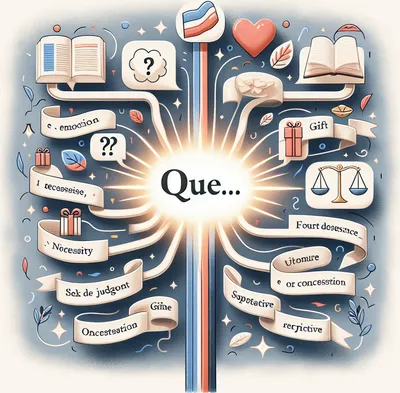
The subjunctive (subjonctif) is the tense that marks the boundary between A2/B1 and B2 French. It signals that the clause contains something subjective — a wish, a doubt, a necessity, an emotion, a judgement.
The core question is: when does French use the subjunctive?
🔵 The core rule: The subjunctive appears in subordinate clauses introduced by que, when the main clause expresses something subjective (emotion, will, doubt, obligation, judgement) rather than objective fact.
Forming the subjunctive
Take the ils/elles present tense form, drop the -ent, add these endings:
que je    -e         que nous  -ions
que tu    -es        que vous  -iez
qu'il     -e         qu'ils    -ent
VERB ILS FORM STEM QUE JE...
parler parlent parl- que je parle
finir finissent finiss- que je finisse
boire boivent boiv- que je boive
prendre prennent prenn- que je prenne
venir viennent vienn- que je vienneIrregular subjunctive forms (memorise these):
être        que je sois, que tu sois, qu'il soit, que nous soyons...
avoir       que j'aie, que tu aies, qu'il ait, que nous ayons...
aller       que j'aille, que tu ailles, qu'il aille, que nous allions...
faire       que je fasse, que tu fasses, qu'il fasse, que nous fassions...
pouvoir     que je puisse...
savoir      que je sache...
vouloir     que je veuille...
Full present subjunctive — high-frequency irregulars (memorise as blocks):
| Person | être | avoir | faire | aller | pouvoir | savoir | vouloir |
|---|---|---|---|---|---|---|---|
| que je | sois | aie | fasse | aille | puisse | sache | veuille |
| que tu | sois | aies | fasses | ailles | puisses | saches | veuilles |
| qu'il/elle/on | soit | ait | fasse | aille | puisse | sache | veuille |
| que nous | soyons | ayons | fassions | allions | puissions | sachions | voulions |
| que vous | soyez | ayez | fassiez | alliez | puissiez | sachiez | veuillez |
| qu'ils/elles | soient | aient | fassent | aillent | puissent | sachent | veuillent |
Regular *-er* model (*parler*) and *-ir* model (*finir*) — full six persons:
| Person | parler | finir |
|---|---|---|
| que je | parle | finisse |
| que tu | parles | finisses |
| qu'il/elle | parle | finisse |
| que nous | parlions | finissions |
| que vous | parliez | finissiez |
| qu'ils/elles | parlent | finissent |
When to use the subjunctive — the seven triggers
1. Expressions of will, desire, preference
Je veux que tu viennes.          → I want you to come.
Il préfère qu'on parte.          → He prefers that we leave.
Nous souhaitons que cela change. → We hope this will change.
2. Expressions of emotion
Je suis content que tu sois là.  → I'm glad you're here.
Il est triste qu'elle parte.     → He's sad she's leaving.
C'est dommage que ce soit fini.  → It's a shame it's over.
3. Expressions of doubt and uncertainty
Je doute qu'il vienne.           → I doubt he'll come.
Il n'est pas sûr que ce soit vrai. → He's not sure it's true.
Je ne crois pas que ce soit possible. → I don't think it's possible.
⚠️ Croire / penser — the exam favourite Affirmative main clause → indicative (you assert a belief as aligned with reality): Je crois qu'il vient. / Je pense qu'il a raison. Negative or interrogative main clause → subjunctive (you withhold or question alignment): Je ne crois pas qu'il vienne. / Ne pensez-vous pas qu'il soit trop tard ? The positive treats the subordinate clause as something you stand behind; the negative or question marks it as non-integrated — classic subjunctive territory. Examiners recycle this in grammar and in production correction.
4. Expressions of necessity and obligation
Il faut que tu partes maintenant. → You have to leave now.
Il est nécessaire qu'il soit présent. → It's necessary that he be present.
Il est important que nous agissions. → It's important that we act.
5. Impersonal expressions of judgement
Il est possible qu'il ait raison.   → It's possible he's right.
Il est étrange qu'elle ne réponde pas. → It's strange she's not answering.
Il vaut mieux qu'on attende.         → It's better that we wait.
Il est regrettable que ce soit ainsi. → It's unfortunate it's this way.
6. Certain conjunctions (always trigger subjunctive)
bien que / quoique   → although    Bien qu'il soit fatigué, il travaille.
pour que             → so that     Je parle lentement pour qu'il comprenne.
avant que            → before      Partez avant qu'il arrive.
à moins que          → unless      À moins qu'il ne vienne, on part.
jusqu'à ce que       → until       Attendons jusqu'à ce qu'il arrive.
de peur que          → for fear that  Je n'en parle pas de peur qu'il soit blessé.
7. Superlatives and restrictive expressions
C'est le meilleur film que j'aie vu.    → It's the best film I've seen.
C'est la seule solution qui soit viable. → It's the only solution that's viable.
Il n'y a rien qui puisse l'arrêter.     → There's nothing that can stop him.
🎯 DELF writing: The subjunctive is one of the key markers of B2 competence. Using it correctly — especially with bien que, pour que, il est important que — signals upper-intermediate mastery. Aim to use the subjunctive at least 3 times in your essay: once in a concession (bien qu'il soit vrai que...), once with a necessity expression (il est essentiel que...), and once with doubt (je doute que...).
4. The Conditional: Politeness, Hypothesis, and Journalistic Conditional
The conditional (conditionnel) serves three main functions in B2 French.
Forming the conditional
Take the future stem (usually the infinitive) + imperfect endings:
ENDINGS: -ais / -ais / -ait / -ions / -iez / -aient

parler → je parlerais, tu parlerais, il parlerait, nous parlerions...
finir  → je finirais...
avoir  → j'aurais...  (irregular stem: aur-)
être   → je serais... (irregular stem: ser-)
aller  → j'irais...   (irregular stem: ir-)
faire  → je ferais... (irregular stem: fer-)
pouvoir → je pourrais... (irregular stem: pourr-)
vouloir → je voudrais... (irregular stem: voudr-)
savoir  → je saurais... (irregular stem: saur-)
venir   → je viendrais... (irregular stem: viendr-)
Function 1: Politeness and softening requests
The conditional makes requests, suggestions, and wishes sound less direct — essential for formal writing and the oral exam.
Je veux un café.             → I want a coffee.    (direct, blunt)
Je voudrais un café.         → I'd like a coffee.  (polite ✓)

Pouvez-vous m'aider ?        → Can you help me?
Pourriez-vous m'aider ?      → Could you help me?  (more formal ✓)

Je veux savoir si...         → I want to know if...
Je souhaiterais savoir si... → I would like to know if... (formal ✓)
Function 2: Hypothesis (si + imparfait → conditionnel)
Si j'avais le temps, je voyagerais plus.
→ If I had the time, I would travel more.

Si le gouvernement agissait, la situation s'améliorerait.
→ If the government acted, the situation would improve.

Si j'étais président, je changerais cette loi.
→ If I were president, I would change this law.
🔵 The si + tense rule: ``` Si + présent → futur (real possibility) Si tu travailles, tu réussiras. If you work, you will succeed. Si + imparfait → conditionnel (hypothetical) Si tu travaillais, tu réussirais. If you worked, you would succeed. Si + plus-que-parfait → conditionnel passé (impossible past) Si tu avais travaillé, tu aurais réussi. If you had worked, you would have succeeded. ```
Function 3: Journalistic conditional (reported, unverified “would”)
This is distinctively French in media register: the conditional presents a claim the journalist does not vouch for — hearsay, leak, or analysis — without committing to the indicative.
Selon des sources, le ministre démissionnerait demain.
→ According to sources, the minister is allegedly resigning tomorrow.

D'après le rapport, les émissions auraient augmenté de 15%.
→ According to the report, emissions have allegedly increased by 15%.
🎯 DELF writing: Using je voudrais souligner que..., il conviendrait de..., on pourrait arguer que... in your essay signals B2 register control. These conditional forms soften assertions and sound more academically appropriate than direct statements.
5. Tenses at B2: The Full Picture
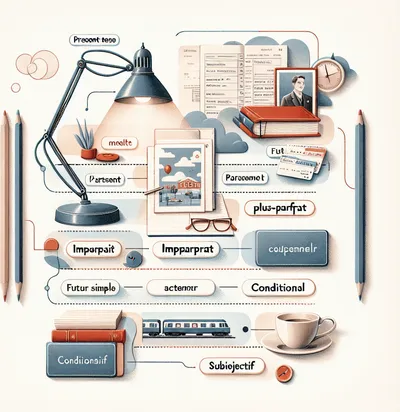
At B2, you need full command of six tenses. Here's each one, when to use it, and what it expresses.
Présent
Used for: current states, habits, general truths, scheduled events, and the "historical present" in writing.
La France compte 68 millions d'habitants.   → France has 68 million inhabitants.
Il lit le journal chaque matin.              → He reads the paper every morning.
En 1789, la Révolution éclate.              → In 1789, the Revolution breaks out. (hist. present)
Passé composé
Used for: completed actions, events that happened at a specific time, sequences of events.
Formed with avoir or être + past participle.
Verbs that take être: movement verbs and reflexive verbs — aller, venir, partir, arriver, entrer, sortir, monter, descendre, naître, mourir, rester, tomber, rentrer, retourner, passer (in some uses).
Il est parti à 8 heures.             → He left at 8 o'clock.
Nous avons discuté pendant une heure.→ We discussed for an hour.
Elle s'est levée tôt.                → She got up early.
⚠️ Agreement with être verbs: When the auxiliary is être, the past participle agrees with the subject. Elle est arrivée. (fem. singular → -e) Ils sont partis. (masc. plural → -s) Elles sont venues. (fem. plural → -es) With avoir, the past participle agrees only when a direct object (COD) stands before the auxiliary — often que (relative), le / la / les, or interrogative quel(le)(s): Les lettres qu'elle a écrites. — Je les ai lues. — Quelle chance as-tu eue ! Il a écrit la lettre. / Il a écrit plusieurs lettres. (COD after the verb → no agreement) Traps B2 examiners like: with en, the quantified object is not a preceding COD in the same way → J'en ai mangé. (no agreement). With combien de + noun inverted, the COD precedes → Combien de messages as-tu envoyés ?
Imparfait
Used for: background descriptions, ongoing past states, habitual past actions, and the "interrupted action" context.
Formed: take nous present form, drop -ons, add: -ais / -ais / -ait / -ions / -iez / -aient
Quand j'étais enfant, je jouais dehors.   → When I was a child, I played outside. (habit)
Il pleuvait quand je suis arrivé.         → It was raining when I arrived. (background)
Elle lisait quand le téléphone a sonné.   → She was reading when the phone rang. (interrupted)
🔵 Passé composé vs imparfait — the key distinction: Passé composé = the event (what happened, the foreground) Imparfait = the context (what was happening, the background) Il lisait (background) quand le téléphone a sonné (event). He was reading when the phone rang.
Plus-que-parfait
Used for: an action completed before another past action — the "past of the past."
Formed: avoir/être in imparfait + past participle.
Il avait déjà mangé quand je suis arrivé.
→ He had already eaten when I arrived.

Quand nous sommes arrivés, ils étaient partis.
→ When we arrived, they had already left.

Elle n'avait jamais vu la mer avant ce voyage.
→ She had never seen the sea before this trip.
Futur simple
Used for: future events, predictions, formal promises.
Demain, il pleuvra dans le nord.     → Tomorrow it will rain in the north.
Le gouvernement présentera son plan. → The government will present its plan.
Conditionnel présent
Already covered in Section 4. At B2 level, also used in the conclusion of essays:
En conclusion, il serait souhaitable que...  → In conclusion, it would be desirable that...
On pourrait donc affirmer que...             → One could therefore affirm that...
Subjonctif présent
Already covered in Section 3. Used in subordinate clauses after triggers of emotion, will, doubt, necessity, and certain conjunctions.
6. Multi-Meaning Verbs: One Word, Many Uses
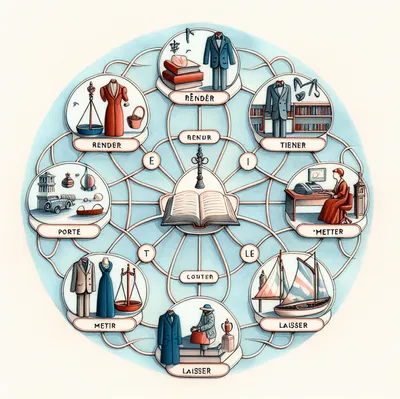
French has a set of verbs whose single core logic generates multiple English translations. Learning the logic — not the list of translations — is faster and more durable.
rendre — to give back, to make, to render
Core logic: causing something to go back to a state or to someone.
Rends-moi mon livre.             → Give me back my book.
Ça me rend heureux.              → That makes me happy.       (rendre + adjective)
Elle se rend au bureau à pied.   → She goes to the office on foot.
L'armée s'est rendue.            → The army surrendered.
Je me rends compte que j'ai tort.→ I realise I'm wrong.
Rendre hommage aux victimes.     → To pay tribute to the victims.
Rendre service à quelqu'un.      → To do someone a favour.
💡 *Rendre + adjective is extremely productive in B2 writing: rendre possible (to make possible), rendre nécessaire (to make necessary), rendre difficile (to make difficult), rendre public* (to make public). Learn this construction and use it in your essay.
tenir — to hold, to keep, to maintain, to take after
Core logic: maintaining something in position — physical, social, or logical.
Tiens la porte, s'il te plaît.   → Hold the door, please.
Il tient sa promesse.            → He keeps his promise.
Elle tient de sa mère.           → She takes after her mother.
Tiens !                          → Here you go! / Well, look at that!
Tenir à quelque chose.           → To value something / care about something.
Tenir compte de...               → To take into account...
Tenir une réunion.               → To hold a meeting.
Se tenir au courant.             → To keep up to date.
Il tient à venir.                → He is keen to come. / He insists on coming.
porter — to carry, to wear, to bring, to bear
Core logic: supporting and moving a load — physical or abstract.
Elle porte un manteau bleu.      → She is wearing a blue coat.
Il porte ses enfants.            → He carries his children.
Ce pont porte 20 tonnes.         → This bridge bears 20 tonnes.
Porter plainte.                  → To file a complaint.
Porter atteinte à...             → To harm / to undermine...
Porter ses fruits.               → To bear fruit (to yield results).
Se porter bien / mal.            → To be in good / poor health.
Comment vous portez-vous ?       → How are you? (formal)
Porter un toast.                 → To make a toast.
mettre — to put, to place, to take (time), to switch on
Core logic: placing something somewhere — physically or in a state.
Mets le livre sur la table.      → Put the book on the table.
Ça m'a mis en colère.            → That made me angry. (put me in anger)
Il a mis deux heures pour finir. → He took two hours to finish.
Mets le chauffage.               → Turn on the heating.
Se mettre à + infinitive.        → To start doing something.
Il s'est mis à pleuvoir.         → It started raining.
Se mettre en route.              → To set off / to get going.
Mettre en œuvre.                 → To implement.
Mettre en place.                 → To put in place / to set up.
Mettre en cause.                 → To call into question.
🎯 DELF writing: Mettre en place, mettre en œuvre, and mettre en cause are register-appropriate expressions that appear in B2 writing about policy, society, and change. Le gouvernement a mis en place de nouvelles mesures (The government has put in place new measures). Use them.
laisser — to leave, to let, to allow, to cause
Core logic: releasing control — of a situation, an object, or a person.
Laisse tes affaires ici.         → Leave your things here.
Laisse-moi parler.               → Let me speak.
Laisse tomber.                   → Drop it. / Forget it.
Ça m'a laissé sans voix.         → It left me speechless.
Laisser à désirer.               → To leave something to be desired.
Laisser entendre que...          → To imply that...
Se laisser aller.                → To let oneself go.
Se laisser convaincre.           → To allow oneself to be convinced.
7. Modal and Semi-Modal Constructions
At B2, the modal system extends beyond pouvoir/vouloir/devoir into nuanced semi-modal expressions that distinguish natural B2 writing from awkward B1.
The core modals
MODAL          MEANING                  EXAMPLE
pouvoir        can / be able to         Je peux venir demain.
devoir         must / should / owe      Je dois partir. / Tu lui dois des excuses.
vouloir        to want                  Je veux comprendre.
savoir         to know how to           Je sais nager.
falloir (il)   must / it is necessary   Il faut agir maintenant.
valoir mieux   it is better             Il vaut mieux attendre.
Semi-modal constructions at B2
These are phrase-level constructions that function like modals but carry more nuance:
EXPRESSION              MEANING                    EXAMPLE
être en mesure de       to be in a position to     Il n'est pas en mesure de répondre.
être à même de          to be capable of           Elle est à même de diriger le projet.
être susceptible de     to be likely to            Ce projet est susceptible d'échouer.
être censé(e)           to be supposed to          Il est censé arriver à midi.
avoir tendance à        to tend to                 J'ai tendance à procrastiner.
avoir du mal à          to have difficulty doing   Elle a du mal à s'exprimer.
avoir beau + inf.       however much one...        Il a beau essayer, il n'y arrive pas.
ne pas manquer de       to be sure to              Il ne manquera pas de vous contacter.
ne faire que            to do nothing but          Il ne fait que se plaindre.
Le gouvernement n'est pas en mesure de garantir la sécurité.
→ The government is not in a position to guarantee security.
Cette décision est susceptible de provoquer des protestations.
→ This decision is likely to provoke protests.
Il a beau travailler dur, il n'obtient pas les résultats espérés.
→ However hard he works, he doesn't get the expected results.🎯 DELF writing: Replace simple pouvoir with être en mesure de in formal contexts. Replace probablement with être susceptible de. These substitutions shift your writing from B1 to B2 register immediately.
8. Passive Voice: When the Action Matters More Than the Actor
The passive voice is used when the action or its result is more important than who performed it. It appears constantly in formal French — journalism, reports, legislation, academic writing.
Forming the passive
Être (in any tense) + past participle (agrees with subject):
ACTIVE:   Le parlement vote la loi.        The parliament votes the law.
PASSIVE:  La loi est votée par le parlement. The law is voted by parliament.

ACTIVE:   On a construit ce pont en 1950.   They built this bridge in 1950.
PASSIVE:  Ce pont a été construit en 1950.  This bridge was built in 1950.

ACTIVE:   Le gouvernement prendra des mesures.
PASSIVE:  Des mesures seront prises.        Measures will be taken.
Agreement in the passive
The past participle agrees with the subject (the noun being acted upon):
La décision a été prise.         → The decision was taken. (fem. sing. → -e)
Les résultats ont été publiés.   → The results were published. (masc. pl. → -s)
Les victimes ont été identifiées.→ The victims were identified. (fem. pl. → -es)
On + active as an alternative to passive
French often avoids the passive by using on (impersonal "one/we/they"):
PASSIVE:  La loi a été modifiée.           The law was modified.
WITH ON:  On a modifié la loi.             They modified the law.
Both are correct at B2. On sounds slightly less formal; the passive sounds more official.
🎯 DELF reading: Passive constructions appear constantly in the texts the exam uses (newspaper articles, reports, official documents). Recognising passive constructions automatically is essential for reading speed — especially when the par (by) agent is absent: Des mesures ont été prises (Measures have been taken — by whom is not stated).
9. Nominalisation at B2: Abstract Register
In French, nominalisation (turning processes into nouns) is not a stylistic extra — it is the main audible shift from B1 storytelling to B2 argument. Examiners hear l'amélioration des conditions before they hear on a amélioré les conditions as “essay French.”
Core pattern
| B1-style (verb-led) | B2-style (noun-led) |
|---|---|
| Il a décidé de partir. | sa décision de partir |
| Le chômage augmente. | l'augmentation du chômage |
| On a négocié un accord. | la négociation d'un accord |
| La situation se dégrade. | la dégradation de la situation |
| Ils ont investi massivement. | un investissement massif |
Productive suffixes (recognise and reuse)
| Suffix | Often from | Examples |
|---|---|---|
| -tion | verbs in -er / -ir | l'éducation, la régulation, l'évaluation |
| -ment | adverbs / verbs | le développement, le gouvernement, l'aménagement |
| -age | verb stem | le chômage, le recyclage, le signalement |
| -ure | irregular stems | la couverture, la fermeture, la créature (set phrases) |
| -isme / -iste | doctrines / roles | l'écologisme, un décisionniste |
Prep + noun instead of subordinate clause
| Verbal | Nominal |
|---|---|
| parce que la loi change | en raison du changement de la loi |
| pour réduire les risques | dans une logique de réduction des risques |
| avant d'agir | avant toute action / préalablement à toute mesure |
🎯 DELF writing: In your production text, aim for at least two clear nominalisations in the development — e.g. la prise en compte des enjeux, la mise en œuvre des mesures, l'évolution de la situation. Pair them with connectors (Section 11); avoid stacking three heavy nouns in a row without de / à / pour links.
10. Building B2 Sentences: Complexity and Nuance

B2 writing is distinguished from B1 not just by tenses but by sentence architecture — the ability to pack more information into a single, well-structured sentence.
Relative pronouns — extending sentences
PRONOUN    USE                        EXAMPLE
qui        subject of relative clause La femme qui parle est ministre.
que        object of relative clause  Le livre que j'ai lu est excellent.
où         place or time              La ville où je vis s'appelle Lyon.
dont       possession / de + noun     L'auteur dont j'ai lu le livre...
           after verbs taking de      Le problème dont il parle est sérieux.
lequel     after a preposition        La raison pour laquelle il a refusé...
(masc.)    (pour lequel, dans lequel) L'organisation au sein de laquelle...
B1: C'est un problème important. Il faut le résoudre rapidement.
B2: C'est un problème important dont la résolution ne peut plus attendre.
→ It's an important problem whose resolution can wait no longer.
B1: J'ai rencontré une femme. Elle dirige une ONG.
B2: J'ai rencontré une femme qui dirige une ONG.
→ I met a woman who runs an NGO.
B1: Il y a des raisons. Pour ces raisons, il a refusé.
B2: Les raisons pour lesquelles il a refusé restent obscures.
→ The reasons for which he refused remain unclear.Nominalisation — link to Section 9
You now have a full section on nominalisation (Section 9). Here the focus stays on syntax: relative clauses and impersonals that let you embed those abstract nouns cleanly.
Impersonal constructions
These allow you to state positions without using je — more academic, more assertive:
Il est indéniable que...         → It is undeniable that...
Il convient de noter que...      → It is worth noting that...
Il s'avère que...                → It turns out that...
Force est de constater que...    → One cannot fail to note that...
Il va sans dire que...           → It goes without saying that...
Il y a lieu de se demander si... → One has reason to wonder whether...
Nul ne peut nier que...          → No one can deny that...
11. Discourse Connectors: The Language of Argument
At B2, connectors are not just transition words — they are the architecture of argument. The DELF B2 essay is scored partly on the quality and variety of its discourse structure.
1) Addition and reinforcement
tout d'abord        → first (structuring)
en premier lieu     → in the first place (formal)
de plus             → furthermore, moreover
en outre            → in addition (formal)
de surcroît         → moreover / on top of that (formal)
qui plus est        → what's more (stronger)
par ailleurs        → moreover / on the other hand
en même temps       → at the same time
dans le même temps  → meanwhile
non seulement... mais aussi → not only... but also
voire               → even, or even (stronger)
d'autant plus que   → all the more so as
également           → likewise
2) Contrast and concession
cependant           → however (formal)
néanmoins           → nevertheless
toutefois           → nonetheless / yet
pourtant            → yet / however
en revanche         → on the other hand (contrast)
à l'inverse         → conversely
inversement         → inversely
or                  → now / however (introduces new element)
certes              → admittedly / certainly (concession)
bien que + subj.    → although
quoique + subj.     → although
malgré + noun       → despite
en dépit de         → in spite of (formal)
malgré tout         → nevertheless / all the same
quoi qu'il en soit  → be that as it may
3) Cause and consequence
car / parce que     → because (car = formal written)
puisque             → since / given that (shared knowledge)
étant donné que     → given that
du fait que         → due to the fact that
en raison de        → because of (+ noun)
grâce à             → thanks to
à cause de          → because of (negative nuance)
c'est pourquoi      → that is why
par conséquent      → consequently
donc                → so (use sparingly in formal essays)
ainsi               → thus / so
en effet            → indeed / in fact
de ce fait          → as a result
dès lors            → from then on / therefore
il s'ensuit que     → it follows that
4) Illustration and exemplification
par exemple         → for example
notamment           → notably / in particular
entre autres        → among other things
en particulier      → in particular
ainsi que           → as well as
tel que             → such as
comme               → like / such as
à l'image de        → like / in the manner of
c'est le cas de     → this is the case for
à titre d'exemple   → by way of example
5) Conclusion and synthesis
en conclusion       → in conclusion
pour conclure       → to conclude
en définitive       → ultimately / in the final analysis
en somme            → in sum
pour résumer        → to sum up
dans l'ensemble     → on the whole
somme toute         → all in all
en fin de compte    → at the end of the day
au bout du compte   → when all is said and done
il ressort de...    → it emerges from...
tout bien considéré → all things considered
🎯 DELF writing: A common B1 mistake is using mais, et, and donc for everything. At B2, vary your connectors deliberately: use cependant instead of mais, de surcroît instead of aussi, c'est pourquoi instead of donc. In your essay, aim for connectors from at least four different categories: addition, contrast, cause, and conclusion.
A model paragraph with B2 connectors
La transition énergétique est devenue une priorité mondiale. Certes, elle
représente un coût considérable pour les États. Néanmoins, les experts
s'accordent à dire que l'inaction serait encore plus coûteuse à long terme.
C'est pourquoi de nombreux gouvernements ont mis en place des politiques
ambitieuses — non seulement pour réduire les émissions, mais aussi pour
stimuler l'économie verte. En définitive, il ne s'agit pas d'un choix
entre l'économie et l'environnement, mais bien d'une opportunité d'allier
les deux.

→ The energy transition has become a global priority. Admittedly, it
represents a considerable cost for states. Nevertheless, experts agree
that inaction would be even more costly in the long run. That is why many
governments have put in place ambitious policies — not only to reduce
emissions but also to stimulate the green economy. Ultimately, this is
not a choice between the economy and the environment, but an opportunity
to combine the two.
Connectors used: certes / néanmoins / c'est pourquoi / non seulement... mais aussi / en définitive
Same paragraph — connector annotation (exam-style)
[Topic sentence — no connector] La transition énergétique est devenue une priorité mondiale.
[Concession — certes] Certes, elle représente un coût considérable pour les États.
[Contrast pivot — néanmoins] Néanmoins, les experts s'accordent à dire que l'inaction serait encore plus coûteuse…
[Cause / consequence — c'est pourquoi + conditional hypothesis] C'est pourquoi de nombreux gouvernements ont mis en place…
[Addition — non seulement… mais aussi] — non seulement pour réduire… mais aussi pour stimuler…
[Synthesis close — en définitive] En définitive, il ne s'agit pas d'un choix…
12. Pronouns at B2: Relative, Demonstrative, Indefinite
Relative pronouns (recap and extension)
Already covered in Section 10. The key ones for B2:
dont       → whose / of which / about which
Ce dont il s'agit, c'est...     → What this is about is...
Ce dont j'ai besoin, c'est...   → What I need is...

où         → where / when (time)
Le moment où tout a changé...   → The moment when everything changed...
Le pays où il vit...            → The country where he lives...

lequel/laquelle  → which (after prepositions)
Le projet auquel il participe... → The project he's participating in...
La raison pour laquelle...       → The reason why...
Demonstrative pronouns
celui/celle     → the one (singular)
ceux/celles     → the ones (plural)

Celui qui travaille réussit.         → The one who works succeeds.
Ceux dont vous parlez sont absents.  → Those you're speaking of are absent.
C'est celui de mon collègue.         → It's my colleague's (one).
Indefinite pronouns and determiners
These are essential for making general claims in essays:
chacun(e)       → each one, everyone
tout le monde   → everyone
n'importe qui   → anyone (whoever)
n'importe quoi  → anything (whatever)
certains/unes   → some (people / things)
d'autres        → others
plusieurs       → several
la plupart de   → most of
quelques-uns/unes → some (a few)
autrui          → others (formal, literary)
Chacun est libre de s'exprimer. → Everyone is free to express themselves.
La plupart des citoyens s'abstiennent.→ Most citizens abstain.
Certains estiment que c'est injuste. → Some believe it's unfair.
D'autres, en revanche, y voient une solution. → Others, on the other hand, see it as a solution.13. Numbers, Time, Statistics — Reading Data in French

DELF B2 reading and listening frequently involves data — statistics, percentages, trends, timeframes. Reading these fluently is a separate skill.
Large numbers
cent             → 100
mille            → 1,000
un million       → 1,000,000
un milliard      → 1,000,000,000  (≠ English billion)
⚠️ French billion ≠ English billion. Un milliard = 1,000,000,000 (what English calls a billion) Un billion = 1,000,000,000,000 (what English calls a trillion) In DELF reading about economics or population, milliard is the word you'll see for large numbers. Misreading it costs comprehension marks.
Percentages and fractions
20 pour cent     → 20 percent
un quart         → a quarter (1/4)
un tiers         → a third (1/3)
la moitié        → half
les deux tiers   → two thirds
près de          → nearly, close to
environ          → approximately
à peu près       → roughly
plus de          → more than
moins de         → less than
Expressing trends
augmenter / croître       → to increase
diminuer / baisser        → to decrease
stagner                   → to stagnate
progresser                → to progress
se stabiliser             → to stabilise
atteindre un pic          → to reach a peak
chuter                    → to fall sharply
doubler / tripler         → to double / triple
en hausse                 → rising
en baisse                 → falling
en légère hausse          → slightly rising
en forte baisse           → sharply falling
Time expressions at B2
au cours de         → during / in the course of
à l'heure actuelle  → at the present time
désormais           → from now on / henceforth
dorénavant          → henceforth (more formal)
à terme             → in the long run
à court/long terme  → in the short/long term
dans l'immédiat     → for the time being
depuis lors         → since then
d'ici là            → between now and then
🎯 DELF reading: When the text includes statistics (selon une étude, 64% des Français...), the comprehension questions will ask you to identify exact figures, compare data, or draw conclusions. Practice reading data sentences quickly and accurately — numbers in words (not digits) slow down reading speed.
14. Directions and Spatial Language at B2

At B2, spatial language extends beyond giving directions into describing urban environments, planning discussions, and geographical arguments that appear in reading and essay topics.
Basic directions (reference)
à droite         → to the right      Tournez à droite.
à gauche         → to the left       Tournez à gauche.
tout droit       → straight ahead    Continuez tout droit.
en face de       → opposite          En face de la mairie.
au bout de       → at the end of     Au bout de la rue.
au coin de       → at the corner of  Au coin de la rue.
Spatial prepositions at B2
au sein de       → within (formal)   Au sein de l'organisation.
à l'intérieur de → inside of         À l'intérieur du bâtiment.
aux abords de    → in the vicinity of Aux abords de la ville.
à proximité de   → near / close to   À proximité des transports.
à l'écart de     → away from         À l'écart du centre-ville.
en périphérie de → on the periphery  En périphérie de Paris.
au cœur de       → at the heart of   Au cœur du problème.
Spatial and conceptual overlap
At B2, spatial prepositions often appear in abstract contexts — this is a marker of register:
au sein de la société          → within society
au cœur du débat               → at the heart of the debate
en marge de la société         → on the margins of society
à l'échelle nationale          → at the national level
sur le plan économique         → on the economic level/front
dans le cadre de               → within the framework of
15. Colours in French: Basic, Nuanced, and Idiomatic

Colour vocabulary in French goes far beyond the basic palette. At B2, colours appear in reading texts (descriptive passages, cultural content), in listening (visual descriptions, scene-setting), and in speaking (describing images in the oral section). This section covers the complete system.
Basic colours and their agreement
French colour adjectives follow the standard agreement rules — but several have irregular forms or don't agree at all.
COLOUR       MASC. SING.  FEM. SING.   MASC. PL.   FEM. PL.
blanc        blanc        blanche      blancs       blanches
noir         noir         noire        noirs        noires
rouge        rouge        rouge        rouges       rouges
bleu         bleu         bleue        bleus        bleues
vert         vert         verte        verts        vertes
jaune        jaune        jaune        jaunes       jaunes
orange       orange       orange       orange       orange  ← invariable
rose         rose         rose         roses        roses
violet       violet       violette     violets      violettes
gris         gris         grise        gris         grises
brun         brun         brune        bruns        brunes
beige        beige        beige        beige        beige   ← invariable
marron       marron       marron       marron       marron  ← invariable
⚠️ Invariable colours: Colour adjectives derived from nouns (orange, marron, crème, kaki, bordeaux, marine, turquoise) do not agree in gender or number. Des yeux marron (not marrons). Des chaussures orange (not oranges). Une veste bordeaux. This is a common B2 writing error.
Shades and nuances
French has a sophisticated system for expressing shades. These appear in descriptive writing and speaking (DELF oral section: describing a photo or document).
LIGHT / PALE:    clair(e)         un bleu clair       a light blue
DARK:            foncé(e)         un vert foncé       a dark green
BRIGHT/VIVID:    vif/vive         un rouge vif        a bright red
PALE/WASHED:     pâle             un rose pâle        a pale pink
DULL/MUTED:      terne            un gris terne       a dull grey
DEEP:            profond(e)       un bleu profond     a deep blue
Compound colour names
bleu marine      → navy blue         (invariable: des pantalons bleu marine)
bleu ciel        → sky blue
bleu nuit        → midnight blue
vert bouteille   → bottle green
vert olive       → olive green
rouge cerise     → cherry red
rouge brique     → brick red
jaune citron     → lemon yellow
jaune paille     → straw yellow
gris perle       → pearl grey
blanc cassé      → off-white / cream
noir charbon     → charcoal black
⚠️ Compound colours are invariable. Des chaussettes bleu marine (not bleues marines). Des yeux vert bouteille. When a colour is modified by a second word (a noun or adjective), the whole compound stays invariable.
Colour idioms at B2
French uses colour idioms extensively in both formal and informal register. These appear in reading texts and listening audio.
IDIOM / EXPRESSION                    MEANING
être vert(e) de rage                  to be livid with rage
avoir le cafard                       to feel down / depressed
broyer du noir                        to brood; see everything negatively
voir la vie en rose                   to see the world through rose-tinted glasses
rire jaune                            to give a forced laugh
être fleur bleue                      sentimental / naive romantic
faire grise mine                      to look displeased; pull a long face
avoir carte blanche                  to have full discretion / free rein
donner le feu vert                    to give the go-ahead
être dans le rouge                    to be in deficit (accounts)
voir rouge                            to see red; lose one's temper
c'est bonnet blanc et blanc bonnet    six of one, half a dozen of the other
se retrouver dans une situation noire to end up in a very bad situation
noir sur blanc                        in writing; in black and white (proof)
passer une nuit blanche              to stay up all night
de but en blanc                       point-blank (directly, abruptly)
Il était vert de rage quand il a appris la nouvelle.
→ He was livid when he heard the news.
Le gouvernement a donné le feu vert au projet.
→ The government gave the green light to the project.
Elle broie du noir depuis plusieurs semaines.
→ She's been in a very dark mood for several weeks.
L'entreprise est dans le rouge depuis deux trimestres.
→ The company has been in the red for two quarters.
J'ai ri jaune quand j'ai compris qu'il plaisantait.
→ I gave a forced laugh when I realised he was joking.Colours in French cultural and political context
At B2, colour vocabulary extends into cultural and political registers that appear in reading texts:
la France tricolore      → France's tricolour flag (bleu, blanc, rouge)
le drapeau blanc         → the white flag (surrender)
la main verte            → green thumb (gardening ability)
les cols bleus           → blue-collar workers
les cols blancs          → white-collar workers
le mouvement vert        → the green movement (environmentalism)
le parti vert / les écologistes → green party / environmentalists (press register)
le carton rouge / jaune  → red card / yellow card (sport, and fig. politics)
la liste noire           → the blacklist
le marché noir           → the black market
la liste blanche         → the whitelist
🎯 DELF oral section: When describing a document or image in Phase 1, colour vocabulary signals precision and range. Instead of saying une photo avec des gens (a photo with people), say une photographie en noir et blanc représentant des silhouettes sombres sur fond clair (a black-and-white photograph showing dark silhouettes against a light background). Precision in description raises your score under lexical range criteria.
16. 50 Verbs for DELF B2 Topics
The DELF B2 covers social, civic, cultural, and environmental themes. These 50 verbs cover the core actions discussed in essays, debates, and formal texts on those themes.
Society and civic life
affirmer       → to affirm, assert        Il affirme que c'est vrai.
contester      → to challenge, dispute    Contester une décision.
revendiquer    → to claim, demand         Revendiquer ses droits.
s'opposer à    → to oppose                S'opposer à une loi.
défendre       → to defend, argue for     Défendre une position.
approuver      → to approve               Le parlement a approuvé.
rejeter        → to reject                La proposition a été rejetée.
promulguer     → to promulgate            Promulguer une loi.
mettre en œuvre → to implement            Mettre en œuvre une réforme.
Analysis and argument
analyser       → to analyse               Analyser les données.
démontrer      → to demonstrate           Démontrer une hypothèse.
nuancer        → to nuance               Nuancer son propos.
réfuter        → to refute               Réfuter un argument.
souligner      → to underline, stress     Souligner l'importance de.
illustrer      → to illustrate            Illustrer par un exemple.
constater      → to note, observe         Force est de constater que.
déduire        → to deduce               On peut en déduire que.
supposer       → to suppose, assume       En supposant que.
prétendre      → to claim (contested)     Il prétend que c'est faux.
Environment and change
menacer        → to threaten              Menacer l'équilibre naturel.
protéger       → to protect               Protéger les espèces.
réduire        → to reduce               Réduire les émissions.
favoriser      → to favour, promote       Favoriser la croissance.
décourager     → to discourage            Décourager les abus.
contribuer à   → to contribute to         Contribuer au réchauffement.
aggraver       → to worsen               Aggraver la situation.
atténuer       → to mitigate, reduce      Atténuer les effets.
préserver      → to preserve             Préserver les ressources.
pallier        → to offset, remedy        Pallier les insuffisances.
Economy and society
financer       → to finance               Financer un projet.
investir       → to invest                Investir dans l'éducation.
stimuler       → to stimulate             Stimuler la croissance.
redistribuer   → to redistribute          Redistribuer les richesses.
freiner        → to slow, curb            Freiner l'inflation.
accroître      → to increase (formal)     Accroître les inégalités.
résorber       → to absorb, reduce        Résorber le chômage.
peser sur      → to weigh on, burden      Les charges pèsent sur les entreprises.
entraîner      → to lead to, cause        Entraîner des conséquences.
impliquer      → to imply, involve        Cela implique des risques.
Health, culture, technology
prévenir       → to prevent               Prévenir les maladies.
traiter        → to treat, deal with      Traiter un problème.
développer     → to develop               Développer de nouveaux outils.
intégrer       → to integrate             Intégrer de nouvelles technologies.
renforcer      → to strengthen            Renforcer les liens sociaux.
fragiliser     → to weaken, make fragile  Fragiliser le tissu social.
bouleverser    → to overturn, disrupt     Bouleverser les habitudes.
remettre en question → to call into question Remettre en question les certitudes.
s'interroger sur → to question, ponder    S'interroger sur les conséquences.
recourir à     → to resort to, use        Recourir à des mesures d'urgence.
17. Writing Formulas for the DELF B2 Exam
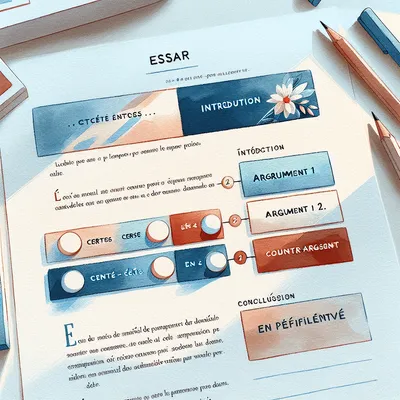
The DELF B2 writing task is a single text of ~250 words. It must be argumentative: state a position, develop arguments, acknowledge the opposing view, conclude.
🔵 The five-part structure: 1. Introduction — state the issue and your position 2. Argument 1 — strongest point + example or evidence 3. Argument 2 — second point from a different angle 4. Counter-argument — acknowledge the opposing view + refute it 5. Conclusion — restate your position in different words
Opening the essay
La question de... est au cœur du débat actuel.
→ The question of... is at the heart of current debate.

Dans un contexte où..., il est légitime de s'interroger sur...
→ In a context where..., it is legitimate to question...

Force est de constater que... pose aujourd'hui un défi majeur.
→ One cannot fail to note that... poses a major challenge today.

Si [position you will argue], c'est parce que...
→ If [position], it is because...
Presenting your arguments
Tout d'abord, il convient de souligner que...
→ First of all, it is worth emphasising that...

En premier lieu, force est de reconnaître que...
→ In the first place, one must recognise that...

À cela s'ajoute le fait que...
→ Added to this is the fact that...

Par ailleurs, il ne faut pas négliger...
→ Furthermore, one should not overlook...

Comme en témoigne [example]...
→ As demonstrated by [example]...
Introducing the counter-argument
Certes, on pourrait objecter que...
→ Admittedly, one could object that...

Il est vrai que certains estiment que...
→ It is true that some believe that...

On ne saurait nier que...
→ One cannot deny that...

D'aucuns affirment que... ; or, cette vision mérite d'être nuancée.
→ Some affirm that...; however, this view deserves to be nuanced.
Refuting the counter-argument
Néanmoins, il reste que...
→ Nevertheless, it remains that...

Cependant, cette position ne tient pas compte du fait que...
→ However, this position fails to account for the fact that...

Pour autant, il serait réducteur de...
→ Even so, it would be reductive to...

Cette objection, bien que recevable, ne suffit pas à...
→ This objection, though valid, is not sufficient to...
Concluding
En définitive, il apparaît que...
→ Ultimately, it appears that...

Au terme de cette réflexion, on peut affirmer que...
→ At the conclusion of this reflection, one can affirm that...

Loin d'être une question résolue, [topic] continuera de...
→ Far from being a settled question, [topic] will continue to...

Il serait souhaitable que + subjunctive.
→ It would be desirable that...
Full model essay (250 words)
SUJET: Faut-il encadrer l'utilisation des réseaux sociaux pour les mineurs ?

Les réseaux sociaux occupent aujourd'hui une place prépondérante dans la vie des
jeunes. Dans un contexte où les études alertent de plus en plus sur leurs effets
sur la santé mentale, la question de leur encadrement pour les mineurs mérite
d'être sérieusement examinée.

Il est indéniable que les réseaux sociaux exposent les adolescents à des risques
réels : cyberharcèlement, comparaison sociale, voire dépendance. Comme en témoignent
plusieurs études récentes, une utilisation intensive est corrélée à une augmentation
des troubles anxieux chez les 13-17 ans. Il paraît donc légitime que les pouvoirs
publics interviennent pour protéger ce public vulnérable.

Par ailleurs, encadrer ne signifie pas interdire. Des mesures telles que la
vérification de l'âge, la limitation du temps d'écran, ou l'obligation d'un
consentement parental constitueraient un progrès sans pour autant priver les
jeunes de tout accès à ces outils.

Certes, on pourrait objecter que cette responsabilité incombe en premier lieu aux
parents. Néanmoins, la réalité est que beaucoup de familles ne disposent pas des
ressources ni des connaissances nécessaires pour exercer ce contrôle efficacement.
Un cadre légal vient précisément combler ce vide.

En définitive, encadrer l'utilisation des réseaux sociaux pour les mineurs n'est
pas une atteinte aux libertés, mais une mesure de protection nécessaire. Il serait
souhaitable que les législateurs agissent rapidement sur ce sujet.

(248 mots)
Structure markup (what examiners reward)
[§1 Intro — context formula] Dans un contexte où… mérite d'être examinée.
[§2 Arg1 — impersonal + subjunctive] Il est indéniable que… ; Il paraît légitime que les pouvoirs publics interviennent…
[§2 — exemplification] Comme en témoignent plusieurs études…
[§2 — passive / result] …est corrélée à une augmentation…
[§3 Arg2 — connector par ailleurs + nominalisation] …la vérification de l'âge… l'obligation d'un consentement…
[§3 — conditional hypothesis] …constitueraient un progrès…
[§4 Contrepoint — certes + infinitive clause] Certes, on pourrait objecter que…
[§4 — néanmoins pivot] Néanmoins, la réalité est que…
[§5 Conclusion — en définitive] En définitive…
[§5 — subjunctive close] Il serait souhaitable que les législateurs agissent…
Inventory: subjunctive (interviennent, agissent), conditional (constitueraient), passive (est corrélée), nominalisations (l'utilisation, l'obligation, la vérification), connectors (certes, néanmoins, par ailleurs, en définitive)
🎯 DELF writing checklist before submitting: ✓ Word count between 220–280 (aim for 250) ✓ Five-part structure: intro / arg 1 / arg 2 / counter-arg / conclusion ✓ At least one subjunctive ✓ At least one conditional ✓ Connectors from contrast, cause, and conclusion categories ✓ No informal register — no je pense que without nuancing, no c'est bien/mal ✓ Formal closing phrase
Putting It All Together

The DELF B2 is a test of intellectual participation in French. It asks whether you can follow a complex argument, analyse a text's position, write a structured essay, and defend your view in a sustained discussion.
Tools for all of that:
- The subjunctive for expressing nuance, obligation, and doubt - The conditional for politeness, hypothesis, and journalistic “would” (unverified reporting) - All six tenses and when each one is appropriate - Multi-meaning verbs whose single logic generates multiple uses - Semi-modal constructions that mark B2 register - Passive voice for formal and journalistic writing - Sentence architecture — relative pronouns, nominalisation (Section 9), impersonal constructions - The full system of discourse connectors for argumentation - Colour vocabulary from basic to idiomatic - 50 verbs for B2 topics in society, environment, economics, and culture - A complete writing formula with a model 250-word essay
B2 competence is not mysterious. It's B1 foundations plus the specific structures in this guide, applied consistently. The exam is not testing fluency — it's testing command of these structures under time pressure.
🎯 Practice, not just study. Write one 250-word essay per week using the template in Section 17. After each essay, check against the four scoring criteria: task completion, coherence, lexical range, grammatical range. Record yourself giving a 5-minute position statement and responding to a challenge. Grammar becomes automatic through use, not through reading.
Ready to test your level? [Browse the DELF B2 mock preview →](https://www.prep2go.study/delf-b2-mock-test#mock-walkthrough)
More DELF Preparation Resources
- Complete DELF B2 exam structure: sections, scoring, note éliminatoire rule, and passing tips
- DELF B2 Anki deck (2,000+ words, clear audio, sample cards)
- DELF A2 printable flashcards (1,000 cards, PDF + QR audio)
- Prep2Go iPhone app — DELF vocabulary flashcards on your phone, no Anki setup
- DELF B2 mock tests, speaking practice, and study plan
Last updated: April 2026. All examples use standard French as required for the DELF B2 exam administered by France Éducation International.